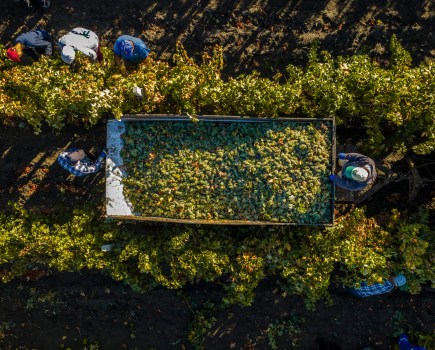


With harvest complete, or nearing completion on many vineyards, Hutchinsons agronomists Rob Saunders and Will Robinson look at the impact of the record-breaking summer and what we can learn for future seasons.
While 2026 could be remembered as a vintage season for some growers, others will look back less fondly, having first had to contend with damaging late frosts in May, followed by repeated heatwaves and drought.
Figures show 54 Met Office weather stations broke their all-time daily maximum temperature record this summer, with the mercury hitting 35°C in late May (Kent), 38°C in June (Norfolk), and 38.2°C in August (Gloucestershire).
Variable impact
This had mixed impacts on vines, often depending on when and where rain fell, the intensity and duration of heatwaves, as well as the variety grown, and its maturity. Older vines, with deep well-established root systems were generally more resilient than younger vines – those carrying a heavy crop really struggled, but early fruit thinning definitely helped.
Generally, harvest has been around 10-14 days earlier than normal, with many crops reaching phenolic ripeness; Sauvignon Blanc, in particular, has had a phenomenal year, with high alcohol levels and phenolic ripeness achieved.
In contrast, Bacchus seems to have struggled more with the intense heat and UV, which may not be a surprise considering the variety was developed for cooler growing regions, with a balance of sunshine and rainfall that allows crops to ripen more slowly.
Figures published by prominent viticulturist, Markus Keller, in his book, Science of Grapevines, suggest the optimal daytime temperature for photosynthesis, growth, yield formation and fruit ripening is below 30°C, with heat stress starting to occur above this. Beyond 35°C, stomata start closing, and once leaf temperatures reach 40-45°C+, a sharp decline in photosynthesis and irreparable damage can occur. Brief periods of extreme heat – as experienced this year – are considered worse than longer periods of moderately high temperatures.
It seems likely that this vine physiology was behind some of the traits observed this season, where sugar development stalled, but acidity continued to decline, which on many sites affected Bacchus in particular.
We cannot control the weather, but there are some steps we can take to help alleviate heat stress, especially in varieties that are potentially more susceptible.
Steps to help alleviate stress
- Mulching with straw or other organic material under vines – this cools the surface, conserves soil moisture, returns some nutrients/organic matter, and feeds soil biology. We have again seen some encouraging responses where an organic fertiliser and soil conditioner based on poultry manure has been used to add nutrients, build structure and stimulate soil biology
- Seaweed-based biostimulants – these contain amino acids that can help relieve stress, and we have seen some notable improvements in Bacchus sugar levels where used this season
- Targeted leaf stripping and canopy management – tailor what you do to the season, don’t just follow the same routine. In some situations, it may be preferable to delay leaf stripping or retain more cover to reduce sunburn risk. At one point this year, some growers went ahead with leaf stripping to try and improve airflow to alleviate high powdery mildew risk, however this did result in some issues with sunburn. One ‘win’ this year was where topping was delayed, until after fruit had set, which reduced the amount of lateral growth and secondary bunches. Several sites did not have any secondaries, largely because vines took so long to grow above the top wire, berries were almost pea-sized by the time they needed trimming. When this did happen, vines were under drought stress, so didn’t throw out more shoots, putting their energy into ripening what was there
- Nutrition – potassium has many roles in vines, but a key one is the regulation of stomatal opening and closing, so ensuring sufficient K can help build resilience to abiotic stress. It is the main nutrient removed at harvest, so monitor requirements closely, especially after a heavy crop. Another important nutrient is calcium, which is crucial for the formation and stability of cell walls
- Applying kaolin – the white, inert, clay effectively forms a ‘sunscreen’ over leaves and fruit, deflecting some UV radiation and reducing leaf temperature
- Review varieties – consider ways to manage risk with careful variety selection. Some growers are now considering top grafting to reduce their area of Bacchus in favour of other varieties, such as Chardonnay or Sauvignon Blanc.