
“It does not happen every year. It cannot happen every year. But last year it did.” – Denbies Wine Estate website relating to Noble Harvest 2025.
When Oz Clarke and Tom Surgey published their annual guide to English wine for 2026, it may have come as a surprise to see late harvest wines amongst the recommendations. But as the English and Welsh wine industry blossoms, and weather permits, more winemakers are experimenting with leaving parcels of grapes on the vine for longer to try their hand at creating sweet wines.
Late harvest wines are still rare beasts in the UK, and noble wines even more so. However, some producers are carving out a successful niche for themselves; diversifying their overall portfolio and offering a point of difference for consumers as a result.
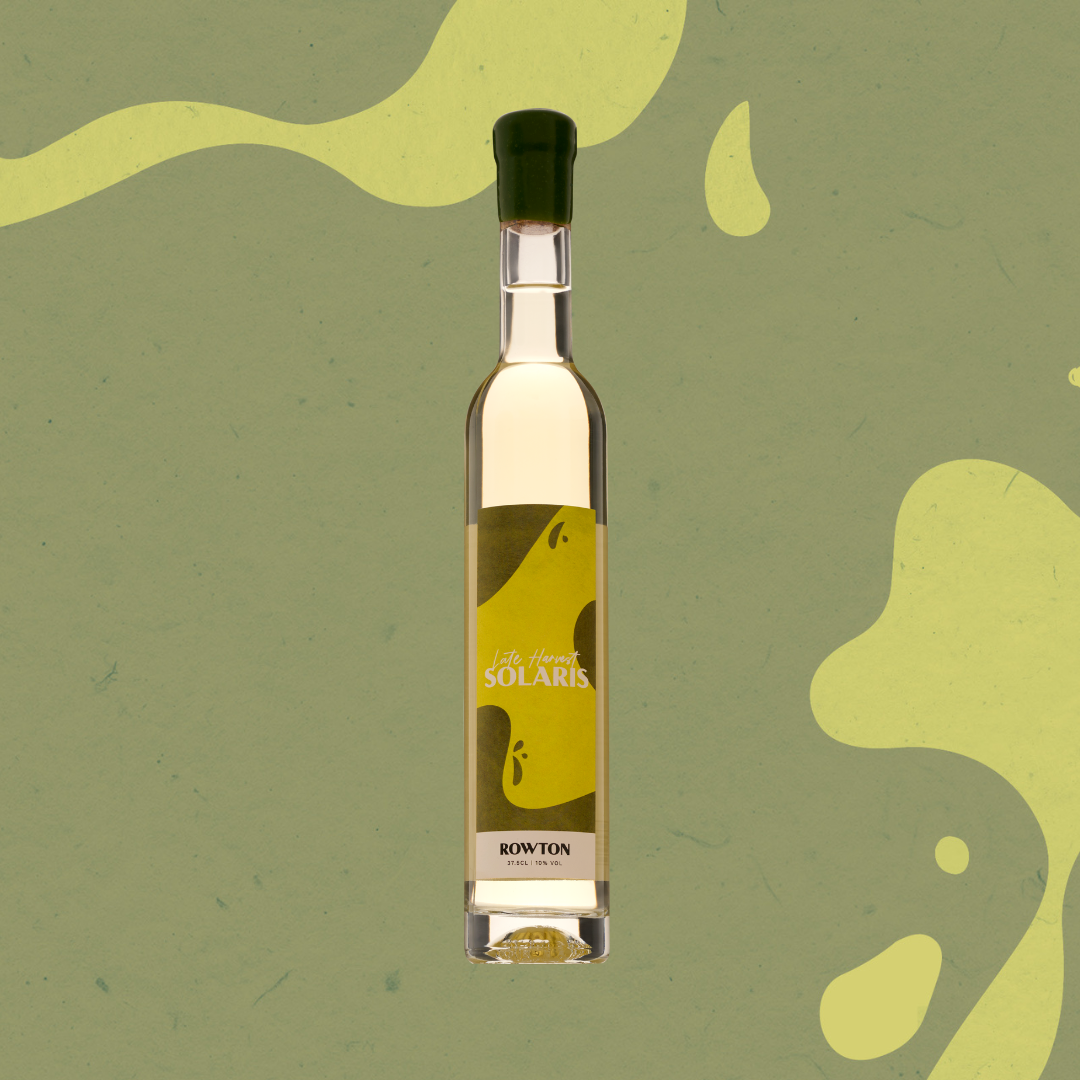
Oz and Tom described the late harvest Solaris from Rowton Vineyard in Shropshire as “lively and moreish”, so it made sense to head to the Midlands first in our investigations into English dessert wines.
Late harvest Solaris
Rowton Vineyard, Shropshire.
Rowton Vineyard is a young business, run by twin sisters Zoë and Melissa Evans. Their first harvest was in 2022 and since the weather was so good, they decided to try their hands at using some of their Solaris for a late harvest wine. Zoë picks up the story:
“The idea had actually come from a study tour Mel and I went on in 2019, visiting vineyards in Germany that were growing some of the varieties we were planning to plant. Partly funded by a grant from the Shropshire Chamber of Agriculture, we visited Hemer, a biodynamic vineyard in Worms-Abenheim, where we tried their Solaris Trockenbeerenauslese. It really stuck with us, and we wanted to see if we could make something similar here in Shropshire.
“Solaris is brilliant for this style because it accumulates sugar quickly while retaining good acidity. We were fortunate that the acidity held up well in 2022, giving us a naturally sweet wine that still has plenty of freshness. We made it again in 2025, and this time we even managed to get some noble rot on the grapes, which added another interesting dimension to the wine.”
Rowton set aside a few rows of the Solaris that would normally be used for sparkling or still wines and leave them hanging for four weeks after the main Solaris harvest. A good summer, followed by a sunny, dry autumn is necessary for the grapes to be left for longer without compromising on quality, so it is always a bit of a gamble.
In order to prepare the plants for this additional hang time, they thin the shoots on the selected vines and remove around half of the bunches. The canopy is also opened up early by removing leaves, so that there is increased airflow to reduce disease pressure and encourage ripening.
“The aim is to give each remaining bunch plenty of space and airflow,” Zoë says. “We want to keep the grapes as healthy as possible for as long as possible. All that work in the vineyard gives us the best chance of getting the extra hang time needed.”
When the time is right, the grapes are hand-picked and transported to the winery in crates before being whole-bunch pressed. The juice is settled in temperature-controlled stainless steel tanks. The fermentation is monitored and stopped at around 10% alcohol, leaving the residual sugar to provide the wine’s natural sweetness.
“We’ve made Late Harvest Solaris twice, in 2022 and 2025,” Zoë continues. “The conditions in 2023 and 2024 weren’t right for us to produce the quality of fruit we wanted. In 2025, we picked our first section of Solaris for sparkling wine on 30 August, followed by our still wine on 5 September. We then left the Late Harvest grapes hanging until 21 October, when we picked them at 110° Oechsle.”
Offering a late harvest wine gives the Evans family something different and memorable to showcase to consumers. Zoë explains further: “It is a really interesting wine for us to have in the range. At markets and tasting events, it often gets people talking because it’s a style they might not expect to find from a small vineyard in Shropshire. It is also a brilliant wine for showing just what Solaris can do. The variety is often used for fresh, aromatic dry wines, but leaving the grapes on the vine for longer allows us to create something completely different.
“Food pairing is another big part of its appeal. It works fantastically well with cheese, particularly our local Shropshire Blue, and it is a great wine to introduce at our tasting events because it can surprise people who think they don’t like sweet wines.”
The wine has also received significant critical acclaim. The late Matthew Jukes honoured the 2022 vintage with a place in his Finest Fifty worldwide wines of 2023, an incredible endorsement for the vineyard.
“It shows brilliant balance,” Matthew wrote. “And for a relatively unknown white grape, this is a stunningly tangy and vivacious offering that will broaden peoples’ repertoires in a moment.”
The wine has picked up several WineGB national and regional awards, as well as finding a home in restaurants like the Michelin-starred Upstairs by Tom Shepherd and Aulis London.
Zoë believes that late harvest wines are relative newcomers on the English and Welsh wine scene not just because of the gamble winemakers need to take on the weather, but also because the grape varieties planted here have historically been focused on sparkling production, where the aim is to retain acidity, rather than to push for ripeness and high sugar levels.
“I think there’s potential for the style to become more established as growers explore what different varieties can do, particularly in warmer years. But it’s still very dependent on the conditions. A warm summer alone isn’t enough; you also need the right autumn weather to keep the grapes healthy while they’re left hanging. That uncertainty is part of what makes these wines relatively rare, and makes a successful vintage all the more rewarding.”
Rowton Vineyard
Late Harvest Solaris 2025
Soft, delectable pear and apple fruit flavours, with the natural sweetness balanced by fresh acidity which stops the opulence becoming overwhelming. Rich and indulgent without feeling heavy, this wine pairs well with the products of its neighbours – Shropshire Blue cheese and Billingham’s gingerbread.
Noble Ortega
Denbies Wine Estate, Surrey.
Noble wines are even rarer than late harvest here in the UK, but they do exist. Perhaps the best known is that made by Denbies Wine Estate, a 40-year old family-run business that is one of England’s largest single-estate vineyards. They first made a botrytised wine in 1995, when the winemaker at the time noticed noble rot in very localised areas of the vineyard and wanted to experiment with the potential for the style.
Andy Kershaw is now the Cellar Master at Denbies and talked to Vineyard magazine about his experiences with dessert wine.
“We’ve experimented with Solaris and even Bacchus in the past, but we almost exclusively use Ortega.
The key is knowing when to commit – when to make the call to leave the bunches hanging, knowing there is a possibility that they will not get to the right stage to make into a delicious sweet wine.
“These decisions involve daily trips to those blocks at various times of the day to make sure we get it right. Picking takes a long time and is always by hand. The vineyard team pass through the same rows over four or five weeks, selecting only the grapes that we’ve specified. We further scrutinise and sort when they arrive at the cellar before crushing and very gently pressing over six hours. After settling we ferment then store in old oak barrels before bottling.”
At what point in the season is the decision taken to make a noble wine?
“The decision is made very early in the ripening season. Conditions have to be almost perfect. We knew that we would make an amazing edition in 2025 as soon as the grapes started going through veraison. We made some Botrytised wine in 2024, but it wasn’t good enough so we bravely made the call to never release it. Equally – in 2026 – we knew very early in the calendar year that we wouldn’t have the conditions to make a Botrytised wine.”
What are the challenges of late harvest wines?
“There are lots. We can leave the grapes to hang and there is a risk that they won’t become infected enough. Other challenges include birds and other animals loving their sweetness and helping themselves, and also – in our case – not having enough volume to make the project viable.”
How are they received by the public?
“Our Late Harvest has built a real following over a long period of time. People ask for this wine and – at times – there is a pressure to produce it. However, we are adamant that we only make it when the end product is true to the vintage, and something that we are proud of. We have long periods – years – where this wine simply isn’t available. But that makes it all the more significant when we release a new version. The price point reflects the outstanding quality, uniqueness and huge time and effort that goes into making each bottle.”
Are they worth the effort?
“At times it feels like ‘no’! The hours – particularly late at night during vintage, when it is invariably cold – can make it feel like a slog too far. But when things come together: the final blending of barrels, the analysis, bottling – it is hugely exciting and very rewarding.”
What do you think late harvest wines tell consumers about Denbies?
“The way that we make this wine shows our diversity and ability to adapt. Production is a full team effort pulling on our joint experience of winemaking across the globe. Our honesty in not being proud is hugely important for us.”
What are your expectations for the future?
“We simply do not know how often we will make these wines. Ortega is a variety that lends itself brilliantly to harbouring Botrytis, but as our climate changes this may shift – and we will constantly monitor the situation and patterns. Our vineyard team is excellent at following the progress of the blocks early in the season, but it is ultimately nature – as always – that is in charge.”
Denbies Wine Estate
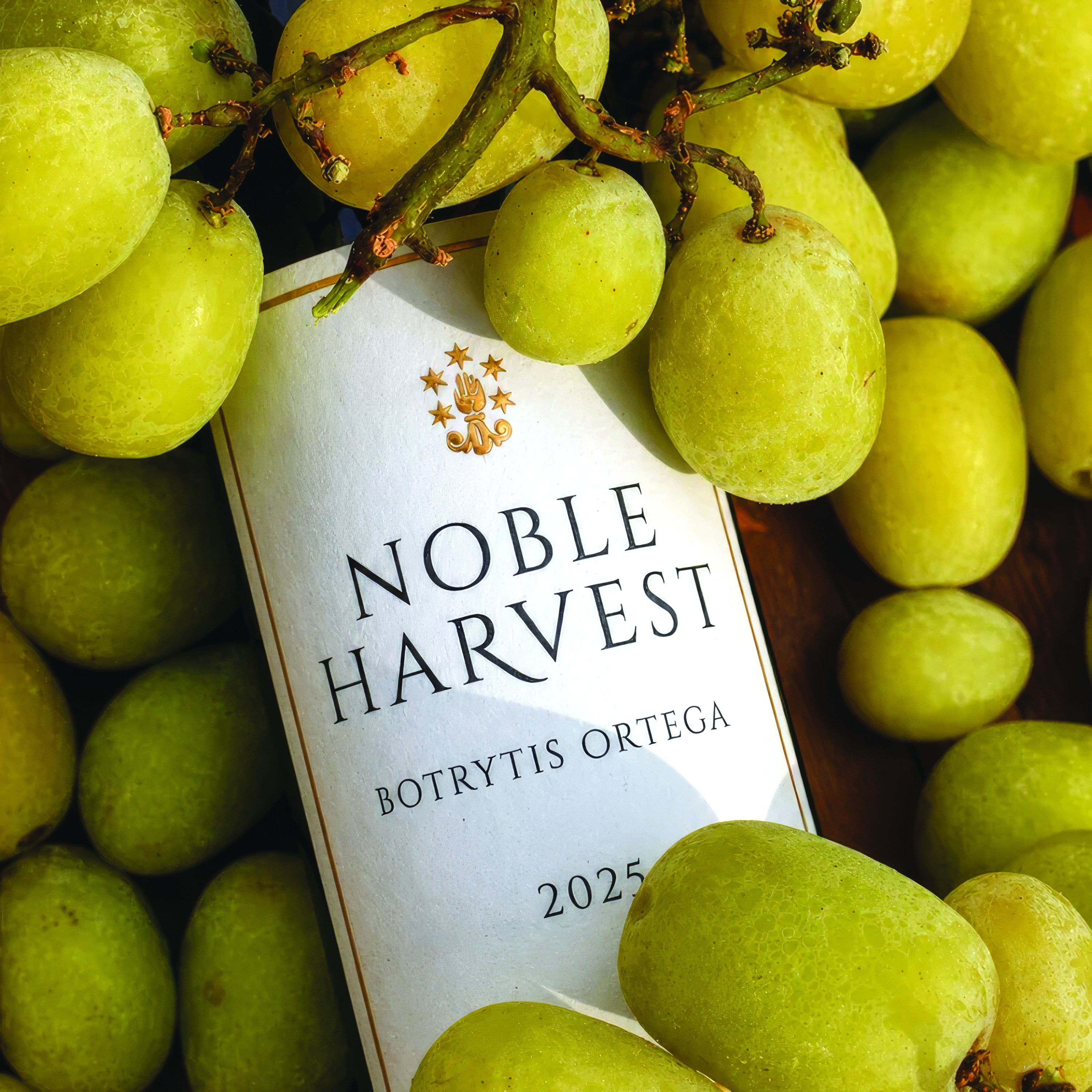
Noble Harvest Botrytised Ortega 2025
Juicy notes of apricot, dripping with floral honey and tempered with a solid backbone of acidity. Pairs beautifully with lightly spiced and fragrant Asian-style dishes.
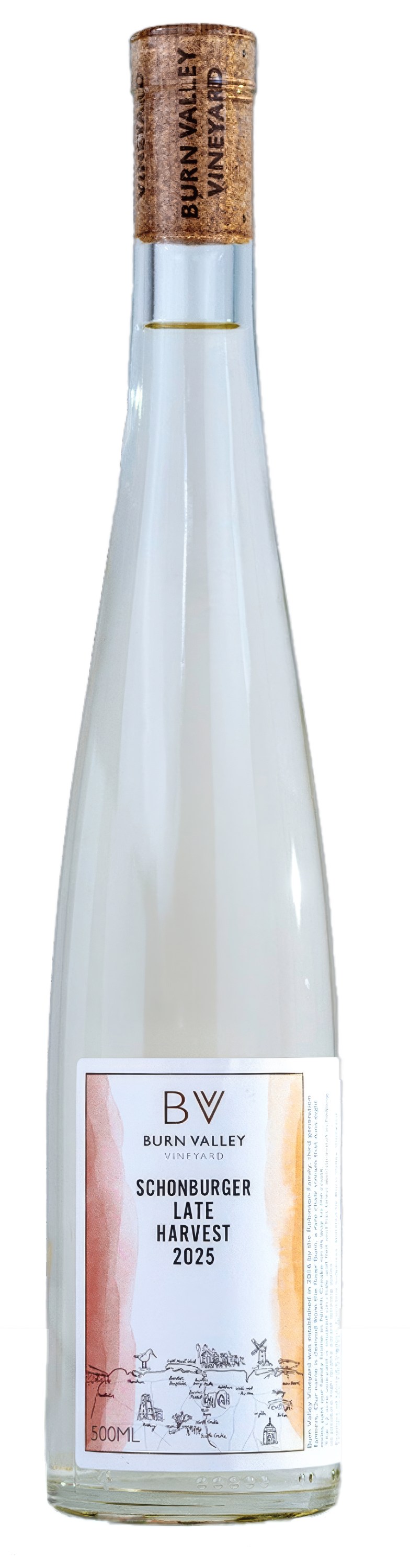
Schonburger Late Harvest
Burn Valley Vineyard, Norfolk.
In its tenth year, Burn Valley Vineyard has had the opportunity to make late harvest wines on a number of occasions, initially using Solaris because of its high sugar levels. Mathew Abbey, Burn Valley’s Head Winemaker, said the first attempt in 2020 was really just a bit of fun.
“We had a little bit left to do a trial, but didn’t have a tank small enough, so I ended up basically having to ferment it in barrel – which obviously you can’t temperature control. It fermented a bit too quickly and ended up being more like a white Port. It was around about 14%, if memory serves, but it still had about 60 grams of residual sugar.”
Mathew went on to make a further two late harvest wines with Solaris – reserving more grapes on these occasions so that the fermentation could be properly managed. Having worked in New Zealand, he had come across a small number of interesting wines in this style before, using Gewürztraminer. This inspired him to give it a try with the aromatic Schonburger, because of its similar flavour profile.
The 2025 wine that he created is 8.5% – significantly lower than was achieved with Solaris.
“A little bit less sugar seems to work quite well with the Schonburger fruit flavours and aromatics,” Mathew reflects. “The British palate has still got a sweet tooth, I’ve always found, that goes back to the wines we used to import into this country that were mostly sweet. It is nice to have a late harvest wine in the portfolio, but we don’t make much. It is usually around 1200 bottles packaged in 50 centilitre bottles.”
Mathew alternates between making a late harvest wine one year and an orange wine the next, to offer something interesting to Burn Valley’s customers; particularly around the festive period. The dessert wines spend a few months in oak before bottling, to help with the oxidative character, then are bottled unfined and unfiltered.
“I learned my trade in New Zealand,” Mathew said. “Using international varieties, but some quirky techniques. It is nice to use that knowledge and skill set in the UK, especially in small batches, because there is no pressure to forcefully sell it – since I am only making it every couple of years. When it sells out, it sells out, and then we are ready for the next one.
“Our wines are typically lasting five years plus across styles, which for young vines is good going. I am trying to make wines that we don’t have to rush and get out too early. We are now at a stage where we are not under a huge amount of pressure to release things when they are not ready, which is quite nice.”
Mathew thinks that there is a gap in the market for sweet wines in the UK, particularly because so much is being imported – from Sauterne to Tokaji.
“Obviously, they have been going for a long time and the quality is there. They have more of the noble rot effect, whereas we are more late harvest. But I learned from my time in New Zealand that you can make really good late harvest wine. It doesn’t have to have the noble rot influence.
“There is always going to be a place in the market for them. The skill is in making sure we don’t make them too expensive, since the cost is typically a little bit higher to make them. There are so few available, people are surprised when they visit us and discover we make a dessert wine. But it is definitely nice to broaden the horizon of wines we can produce. The future is very bright.”
Burn Valley Vineyard
Schonburger Late Harvest 2025
Floral notes of elderflower and lychee intermingle with luscious tropical fruit notes. Slightly drier than previous late harvest wines from Burn Valley, but still perfectly balanced in its acidity. An excellent match for fruit-based desserts.