
Rethinking yeast nutrition.
Balanced nutrition is becoming an increasingly important focus in fermentation management, moving beyond the traditional reliance on YAN (Yeast Assimilable Nitrogen) as a single indicator. While YAN remains useful, it does not fully reflect the complexity of yeast nutritional requirements. A more complete approach considers both the quantity and the composition of nutrients available throughout fermentation.
At its core, balanced nutrition is about providing yeast with a combination of assimilable nitrogen sources, including both ammonium and amino acids. These sources are not interchangeable. Ammonium can be readily taken up by yeast but requires energy to be converted into amino acids. In contrast, amino acids are directly assimilable and can be used more efficiently when available at the right stage.
This distinction is important when designing a fermentation strategy, as the type of nitrogen available directly influences yeast metabolism and fermentation dynamics.
Impact on fermentation performance
Nutrient composition has a direct effect on fermentation kinetics and yeast health. A balanced nutrient profile helps yeast maintain metabolic activity throughout fermentation, even as conditions become more stressful due to rising alcohol levels and nutrient depletion.
Key cellular functions, including membrane integrity and permeability, depend on the availability of compounds such as sterols and fatty acids. When these elements are sufficiently supplied, yeast are better able to tolerate stress and continue fermenting efficiently. The result is a smoother, more predictable fermentation curve with fewer deviations.
Practically, this leads to improved fermentation reliability. Supporting yeast from the start reduces the risk of sluggish or stuck fermentations and helps ensure steady progression through to completion.
Influence on wine quality
Beyond fermentation performance, nutrient management plays an important role in shaping the sensory outcome. Yeast metabolism is closely linked to the production of secondary compounds such as esters and higher alcohols, which contribute to aroma and flavor.
A balanced nutrient supply supports more consistent and complete metabolic activity, often resulting in improved aromatic intensity, greater complexity, and cleaner profiles. In contrast, nutrient imbalances can lead to stress responses that negatively affect both aroma development and overall quality.
For winemakers, nutrition therefore becomes not only a tool for managing fermentation, but also for guiding style and expression.
Applying a balanced nutrition strategy
Achieving balanced nutrition in practice means supporting yeast at key moments with nutrients suited to their physiological needs.
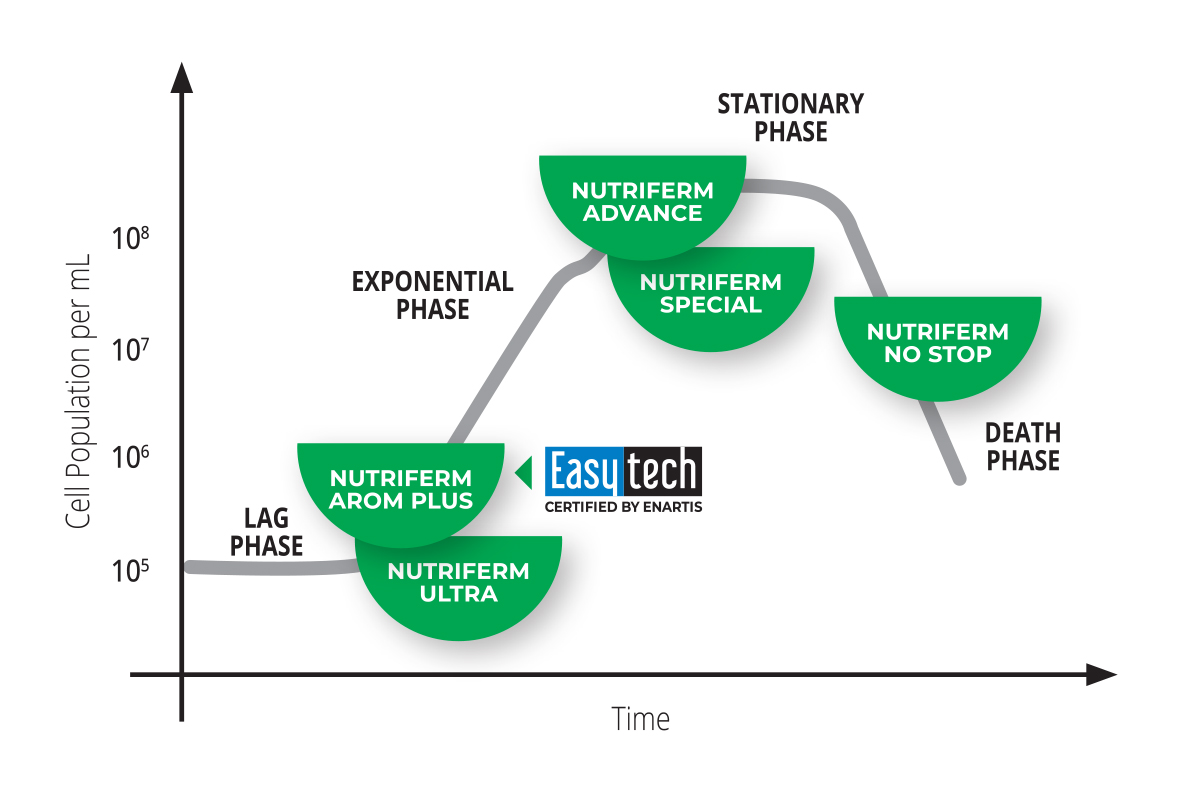
During the early stages, when yeast are adapting and multiplying, Nutriferm Ultra provides organic nutrients rich in amino acids and growth factors, helping establish a healthy fermentation. At the same time, Nutriferm Arom Plus can be used to enhance the availability of amino acid fractions linked to aroma precursor formation, supporting a more expressive profile from the beginning.
As fermentation progresses and stress increases, maintaining yeast activity becomes essential. Nutriferm Advance provides broader nutritional support to sustain yeast viability and metabolic function through mid to late fermentation, helping ensure a steady and controlled process.
In more challenging conditions, such as high sugar musts or nutrient-deficient environments, Nutriferm No Stop can be used to support yeast under stress and reduce the risk of slowdown or arrest, helping maintain fermentation momentum.
A targeted and practical approach
Balanced nutrition is not about adding more, but about adding with purpose. By focusing on nutrient type, composition, and timing, winemakers can improve fermentation consistency while also influencing the final sensory profile.
As fermentation practices continue to evolve, this approach provides a practical way to move toward more controlled, reliable, and quality-driven outcomes.
More information can be found on our website. Looking for further technical support? Reach out to Jennifer Lincoln at Enartis. Products are locally available through Itasca Wines.