
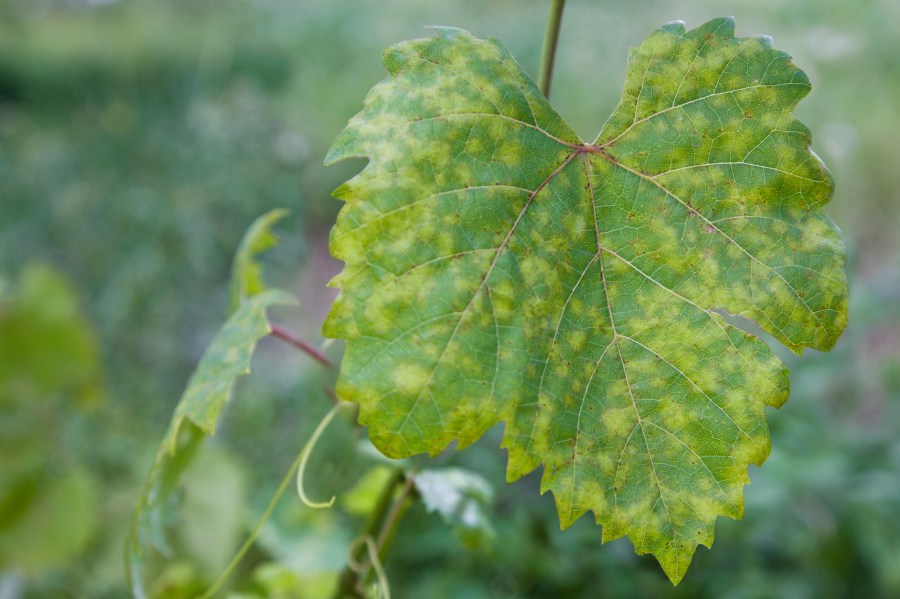
Although pressure from many diseases was generally low in vineyards this year, powdery mildew proved an exception in some hotspot areas. Hutchinsons agronomist, Will Robinson, looks at what happened and how to avoid carrying problems into next season.
Powdery mildew thrives with heat and humidity (25°C-30°C and 40%-100% relative humidity is optimal); conditions many parts of the UK experienced plenty of in 2026. But we also saw some very high levels of UV, something that is known to kill powdery mildew spores, so what went wrong?
Anecdotally, some of the highest pressure from powdery mildew appears to have been in regions with a high density of vineyards, such as Kent, Sussex and parts of Essex, where spores were able to spread between sites more easily. Although powdery mildew affects many crops, the strains are different to those that affect vines, which possibly explains why disease incidence appeared lower in areas with a broader mix of cropping.
Early infection
In many cases, infections first occurred during the busy three-week period around topping, leaf stripping and flowering, where dense canopies quickly formed, reducing airflow – therefore increasing humidity – around inflorescences and newly forming bunches, which are particularly susceptible to infection. Dense foliage also creates more shade within the canopy.
So, while outer leaves are more exposed to UV, which helps control powdery mildew, the situation sometimes looked very different within a thick canopy. Recognise too, that while days were comparatively hot and dry this summer, conditions early in the morning (e.g. 4-6 am) were often a lot more humid, and more conducive to disease infection.
Issues were compounded where growers either reduced, or missed fungicides, given the perceived lower disease risk at the time, potentially allowing powdery mildew to get in.
Once powdery mildew establishes on vines, there are few curative options, given most products offer mainly protectant activity, aside from cyflufenamid, potassium bicarbonate, and proquinazid. Sulphur is another option, but the rates permitted in the UK are insufficient to eradicate disease once established, so remaining in a protectant situation is essential.
Highlight problem areas
If not done already, it is well worth identifying any problem areas, and either map them digitally using a platform like Omnia, or physically tag vines with string or ribbon.
This means that once winter pruning begins, you can easily identify affected material and dispose of it by burning to destroy dormant spores. It also helps ensure that, where possible, only clean, healthy canes are laid down for next season. Overwintering powdery mildew spores can be identified as small, dark, spherical structures on the canes.
Beware flag shoots
Identifying problem areas also allows growers to keep a closer eye on those vines for any signs of flag shoots appearing around bud burst next spring.
Flag shoots are buds that have been fully taken over by powdery mildew, and as they break dormancy the following year, those buds typically develop into fast-growing, spindly, white, shoots that are full of first generation powdery mildew spores.
If flag shoots appear, it is best to remove them completely, place in a paper bag and burn to destroy the spores.
Plan chemistry carefully
Another observation from this season is that some standard sulphur-based chemistry used for powdery mildew control appears to struggle to control disease when used alone in higher-pressure situations.
This may require reducing intervals or reinforcing the protection by including synthetic fungicides along with the sulphur. As sulphur warms up, it volatilises quickly once applied, killing spores in the process, but providing limited long-term protection. Adding synthetic chemistry can extend the protection by up to two weeks.
Utilising different chemistry and modes of action helps manage fungicide resistance risks too, although as a multisite fungicide, the risk of powdery mildew developing resistance to sulphur is thought to be low.
Use indicator species
Several decision support tools are available to help growers predict and monitor powdery mildew risk, but another useful action is to look out for the first occurrence of powdery mildew on other susceptible species, such as roses or oak trees.