
The Sussex PDO is the only geographically specific accreditation in the UK below country level.
English sparkling wine arguably planted its flag in the sands of the global wine industry in April 2016. At a blind tasting held at the Juveniles restaurant in Paris, a group of respected French judges rated a number of English wines more highly than their peers in Champagne.
Among them was Nyetimber’s 2009 vintage. Nyetimber are one of the West Sussex winemaking pioneers. Established in 1988, their estate now encompasses 425 hectares across Sussex, Hampshire and Kent.
Since Nyetimber was founded, climate change has smiled on Sussex. The maritime climate of the county saw an approximate one degree Centigrade rise in average temperatures in the thirty years up to 2020, making one of the UK’s sunniest areas even better placed for the production of sparkling wine. Meanwhile, over the same period, Champagne itself also saw a rise in average temperatures, of about 1.8°C, which has, of course, begun to push the region away from the ideal growing conditions.
Sussex winemakers have got a lot going in their favour, and not just in terms of sparkling production. Along with this (currently beneficial) climatic shift, the area benefits from an advantageous latitude that offers a longer growing season and wide diurnal temperature range. There are also a range of interesting soils available in the area, such as the chalky hills of the South Downs.
These factors have created a unique terroir, ultimately leading to the creation of the Wines of Sussex Protected Designation of Origin (PDO) which was officially recognised by DEFRA in July 2022. The Sussex PDO is the only geographically specific accreditation in the UK below country level – besides Darnibole Bacchus PDO, which is produced in a five-hectare area at Camel Valley Vineyard in Cornwall. A PDO gives customers reassurance about where a product has been produced, as well as the quality standards that are adhered to during production.
Wines of Sussex PDO: implementation
WineGB manages the UK Quality Wine Schemes for still and sparkling to make sure that the rigorous standards associated with this prestigious sign of quality are upheld. Their laboratory partner, Campden BRI, tests every wine entering the scheme so that consumers have assurance about the standards applied to the winemaking process and the preservation of the distinctive character of the region.
The PDO is the highest category for wine in the UK, followed by PGI, which covers wines labelled under the protected terms ‘English Regional’ or ‘Welsh Regional’.
A producer applying for the Sussex PDO has to meet certain quality criteria to use the designation on their labels. As well as growing their grapes entirely within the administrative boundaries of the counties of East and West Sussex, they must meet stringent criteria relating to the vinification process. This includes, but is not limited to, reaching minimum sugar levels at harvest and observing the minimum maturation time in bottle for sparkling wines, which is currently set at 15 months.
In order to be declared a vintage wine, Sussex sparkling must be made from a minimum of 85% grapes from the nominated year. For single variety wines, they must contain at least 90% of the stated variety.
What counts as Sussex?
The administrative borders of the counties of East and West Sussex have been clearly defined for the purposes of the PDO:
The current administrative boundary of West Sussex rises up from a point east of the town of Emsworth, just north of Hayling Island, and passes to the east of Petersfield and south of Haslemere. It then extends east to encompass Crawley and East Grinstead. East Sussex then extends to the south of Royal Tunbridge Wells but includes Rye and borders the Romney marsh to the north of Dungeness. This boundary is shown in the map below and includes the vast majority of the South Downs National Park.
PDO permitted varieties
The terms of the PDO dictates which grape varieties are permitted. As it is a very new designation, the list is much broader than might be seen in most Old World wine-producing regions. This offers makers flexibility and gives the consumer more choice.
For Sussex Sparkling Wine, winemakers must principally use the traditional grape varieties utilised in Champagne for their Traditional Method wines. That is Chardonnay, Pinot Noir and Pinot Meunier. However, they are also allowed to use smaller quantities of Arbanne, Pinot Gris, Pinot Blanc, Petit Meslier and Pinot Noir Précoce.
A Sussex producer could choose to use a different variety altogether – but then they would not be allowed to put ‘Sussex Sparkling’ on the label.
There are 24 permitted grape varieties for PDO still wines of Sussex. The list includes familiar names, like Pinot Noir and Riesling, alongside grapes now common to many English and Welsh vineyards, such as Bacchus and Solaris. Besides that, there are other cold climate grape varieties which are less commonly seen, but still make excellent wines. These include Schonburger, Huxelrebe and Ortega. Many of these grape varieties were first bred in Germany, where a number of new vines suitable for colder climates have been developed in recent decades.
Permitted varieties for still wine production
- Acolon
- Auxerrois
- Bacchus
- Chardonnay
- Dornfelder
- Gamay
- Huxelrebe
- Muller Thurgau
- Orion
- Ortega
- Pinot Blanc
- Pinot Gris
- Pinot Meunier
- Pinot Noir
- Pinot Noir Précoce
- Regent
- Regner
- Reichensteiner
- Riesling
- Rondo
- Roter Veltliner
- Schonburger
- Siegerrebe
- Solaris
A growing move towards collaboration
Of course, since there are stringent regulations for winemakers to follow if they want to use the Wines of Sussex PDO, not every Sussex winemaker chooses to use it for every wine they make. Not every Sussex winemaker grows or sources grapes solely from the county, for example. Others may not be in a position to meet the criteria on maturation or simply choose not to pursue the designation on their bottles.
But that doesn’t stop all of the vineyards in the area from potentially benefitting from the critical mass of production that is becoming more well known amongst the wine drinking public. There is a growing move towards collaboration amongst the numerous producers in both East and West Sussex.
This willingness to combine effort and resource has given rise to the Sussex Winelands, a wine tourism initiative that has a similar feel to Kent’s Wine Garden of England programme, but on a much larger scale. Kent has nine vineyards in its group, while there are some 150 in total across Sussex, so it’s a much larger proposition.
The Rother Wine Triangle
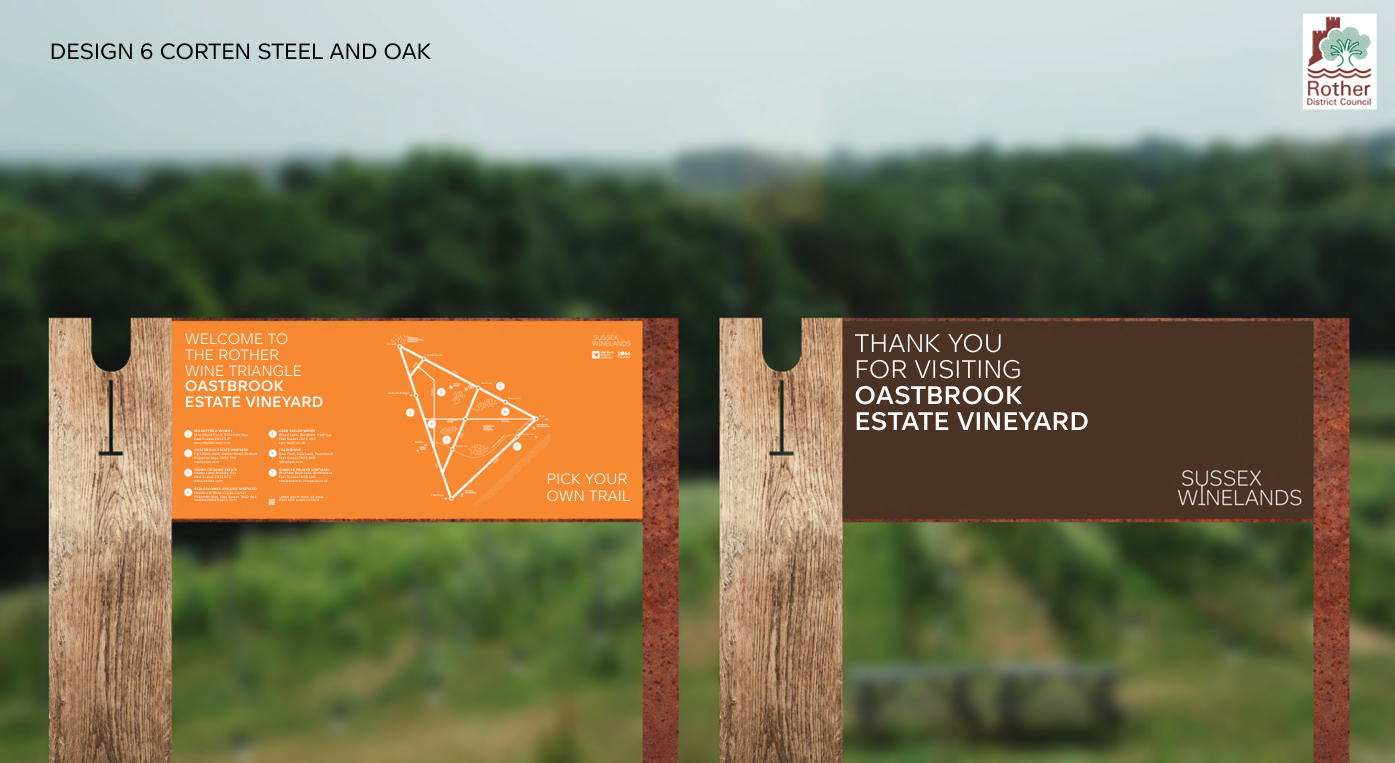
Work on the Sussex Winelands is currently being broken down by unitary authority to create ‘clusters’ of vineyards. This is because the vineyards of the Rother Valley were the first to secure funding for a pilot project, and it came from their district council. The cluster has used the funding to create a trail named the Rother Wine Triangle – Sussex’s first official wine trail.
The services of Studio Playne were engaged to host and design a website and tangible products like printed maps, wayfinding signage and orientation points that have been installed to help make the trail easy to navigate for visitors. The signage also simplifies the way people can navigate the vineyards once they arrive, pointing out the location of key features like the cellar door, shop, cafe and how to get to the vines themselves. It was launched during English Wine Week and has had a great reception. Organised bus tours around the trail have made it even easier for guests to discover what the Rother Wine Triangle has to offer.
“We worked together quite closely as vineyards already,” says Kristin Syltevik of Oxney Organic Estate. “Everyone, more or less, is family-run, everyone has a winery and most of us have accommodation. There are a lot of similarities which we share and talk about.
“We’ve been working very closely with Rother District Council, who have been incredibly helpful, and we’ve been focusing on Instagram in terms of social media. I would say we’re taking our first steps.
“It’s something that I’ve been thinking about a lot, how growers in more established regions historically have that critical mass in order to be able to do things like share equipment. It’s just not been possible in the UK before. But it’s getting to the stage now where we do have the capacity for people to share resources, and also critical mass in terms of people understanding what kind of style is coming out of a particular area.”
The Wealden Wine Trail
The successes at Rother saw Wealden take the plunge next. Again, thanks to some support from the local district council, twelve vineyards were able to collaborate on a trail of the area. They were able to install a modest amount of signage and pay for professional filming and photography. Experts like Oz Clarke and Tom Surgey were brought on board with the project, allowing for a campaign across social media to promote the vineyards of Wealden.
Stopham Vineyard
There are clusters in each area of Sussex; Chichester, Horsham, Wealden etc. Sitting at the top is the Sussex Winelands steering group, with a representative from each district. There is not yet a formal committee or board, since the project is still in its early stages, but it’s clear that the enthusiasm of the membership is helping to drive the initiative forwards, despite it being such a huge project with so many different interests and ideas to represent.
Marie Davies, of Stopham Vineyard in Pulborough is currently the representative for Chichester. “The reason we’re grouping Sussex Winelands in this way is so that we can go to our councils and ask for support. Some are providing funding, some aren’t and some are providing match funding, so it’s quite complicated. Chichester, for example, really wants to push wine tourism but it needs a very compelling reason to provide funding and not put it into other priorities, like youth unemployment, for example. We have to put together a very strong case for councillors.”
The aspiration, as the project evolves, is to pull in more international tourism. Currently there are a good number of visitors from London, as well as a small proportion of international tourists from the US and parts of Scandinavia, for example, but building momentum in this area is perhaps a more long-term goal – once the foundations of the Sussex Winelands are complete.
In the meantime, there are plans to create more incentives for domestic tourists to choose the area. The Lewes cluster put on the Winelands Festival in June, which was a showcase of pop-up events taking place over one week. There were tastings, masterclasses, food and wine pairing evenings and even a special film screening with an interesting “spot-the-fake” wine tasting afterwards. The hope is that a much bigger festival can be organised in the future that covers the whole Sussex Winelands area, but this too will take time, given the scale of wine production in the area.
“Stopham absolutely wants to be part of the Sussex Winelands,” said Marie. “We’re not like Rathfinney or Ridgeview, with a restaurant and lodges – but we do offer tours. That’s the nice thing about Sussex, everybody has their own unique selling point. Stopham is very rustic and has a beautiful 19th century barn. In some places, you can’t actually go into the winery, but that’s where we hold the tastings. It’s about offering different things to meet the needs of different types of consumers.”
Whether you consider the more formal recognition of Sussex winemaking offered by the PDO or the nascent development of a perhaps more informal marketing drive from the Sussex Winelands, it is clear that the English and Welsh wine industry is at a point where the benefit of reaching critical mass is no longer just a pipedream.
Wine tourism in a wider context
By laying claim to this internationally recognised marker of quality, Sussex has created an opportunity to build on its existing wine tourism offer. Jo Williams, Strategic Lead Visitor Economy at Experience Sussex, told Vineyard magazine how wine tourism presents opportunities for the wider Sussex visitor economy:
“Wine tourism is one of the most exciting opportunities within the Sussex visitor economy because it brings together so many of the things that make this place distinctive: our landscape and climate, exceptional local produce, hospitality, food, culture and our growing reputation for world-class wine. Experience Sussex is championing its development because this isn’t simply about encouraging people to visit a vineyard and taste a glass of wine. It is about building a whole visitor experience around wine, encouraging people to stay longer, explore more of Sussex, eat locally, book accommodation and experiences, and ultimately spend more within our rural communities.
“The ambition is significant. The Sussex Wine Tourism Plan for Growth published in 2023 identifies the potential for wine tourism to generate £283 million of economic impact and support 3,633 jobs by 2040, while developing Sussex’s reputation as a world-class wine tourism destination. Importantly, that growth is intended to be responsible and sustainable, with collaboration between vineyards, places and other visitor businesses at its heart.
“What is particularly exciting now is the level of collaboration emerging across Sussex. Around 50 vineyards and wineries offering visitor experiences are represented across six developing Sussex Winelands cluster areas. Rather than every vineyard trying to market itself in isolation, the opportunity is to connect those businesses into trails, itineraries and experiences that give visitors a reason to explore different parts of Sussex. That collaboration powers Sussex from a collection of excellent individual vineyards to a genuinely world-class wine destination.”
Main photo: Artelium Wine Estate ©Will Hearle, Forest Studio