

As English and Welsh still Pinot Noir gains recognition, Andrea Ontiveros Flores, a sommelier and marketing & communications specialist from Alicante, Spain is looking at the key decisions producers face on how to define identity, position their wines, and justify pricing in a market shaped by Burgundy and the New World.
With warming growing seasons and increasingly refined vineyard management, England and Wales are now producing still Pinot Noir that directly competes with more established regions. This progress is gaining not only attention but also widespread industry recognition, with multiple awards to British producers. It is not surprising that Pinot Noir is emerging as a key driver for the future of English and Welsh still wine. According to the latest WineGB industry report, this variety is demonstrating real potential in the UK, producing wines with fragrant aromatics, remarkable structure, and a distinct sense of personality. Moreover, still wine sales grew by around 10% in the UK last year, indicating rising demand for the category, including still Pinot Noir.
And yet, for the average drinker, choosing a still red wine from England is rarely an instinctive decision. In a country that produces wine but remains culturally oriented towards imports, domestic bottles still struggle to inspire the same level of confidence seen in other wine-producing nations, where local consumption dominates. British consumers tend to default to established regions, drawn by familiarity and reputation. Limited awareness of English still red as a serious category only reinforces this, alongside one unavoidable factor: price. Small production volumes, tied to the unpredictability of vintages, mean these wines often sit at a premium, making them harder to position against more recognisable international alternatives, such as Burgundy, the benchmark for this grape.
British Pinot Noir is typically priced between £25–£35 per bottle, with top-tier examples reaching £45 to £65 or more. This is still lower than many wines from Burgundy, the heartland of Pinot Noir, but Burgundy benefits from a 1,000-year legacy, while England’s story spans only a few decades. Producers such as Gusbourne and Danbury Ridge Wine Estate are not simply making still wine; they are entering a category shaped by the most powerful regional brand in wine history. So, are these wines priced too high? How do English and Welsh Pinot Noirs truly compare with those from Burgundy? Does proximity to France make positioning more difficult than for New World regions? If Burgundy defines what Pinot Noir is expected to be, should England try to compete on those terms, or instead redefine the rules of comparison, both in price and in brand identity? And ultimately, what must English and Welsh producers do to make more wine lovers recognise the quality and value of their offering?
The Burgundy game
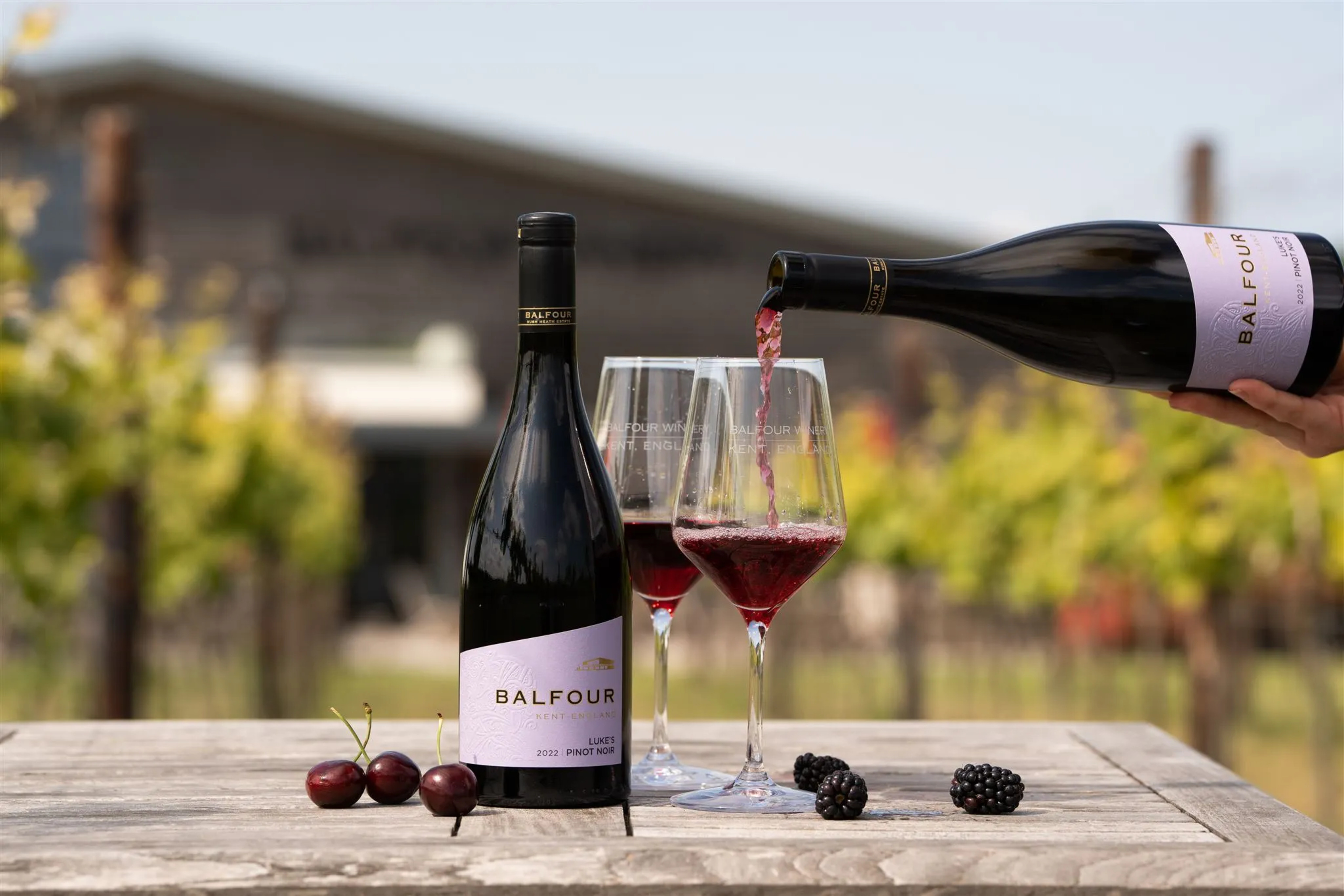
There are three clear strategic paths that English producers are already following. The first is to play the Burgundy game, where the wine style is lean and elegant, supported by terroir-driven messaging and Burgundy-coded language such as “precision” and “purity.” In this approach, producers reinforce Burgundy as the benchmark, while maintaining some local identity through the brightness and depth of English red fruit. The aim is to show that English vineyards can achieve a similar level of finesse, as highlighted by Balfour Winery in its Luke Pinot Noir, often made with Burgundian clones such as 115.
This style has also proven successful for Gusbourne, whose 2022 Pinot Noir was named Best English Red at the International Wine Challenge and has received more than 20 awards. While this approach supports strong fine wine positioning, it carries a risk: by reinforcing Burgundy as the reference point, these wines may be seen as “good… for England” rather than competitive. It can also create pricing challenges, as limited production pushes prices higher, making comparison with Burgundy more difficult.
The New World
The second strategic path is differentiation by aligning more closely with New World Pinot Noir regions such as Oregon, Sonoma County, Central Otago, and the Mornington Peninsula. This approach focuses on riper fruit and greater structure, especially in warmer vintages, together with luxury branding, confident pricing, and a more modern identity. In doing so, English producers are no longer competing primarily with Burgundy, but with the broader New World Pinot Noir category.
The risk is that England’s climate doesn’t always allow for the same level of ripeness or consistency, making this style harder to sustain. On the positive side, distancing from Burgundy reduces the pressure of direct comparison with France, as the wines are positioned within a different stylistic framework. Producers such as Danbury Ridge Wine Estate in Essex follow this approach. Their Pinot Noir combines elements of New World intensity with Burgundian structure, often showing greater concentration than typical cooler-climate English wines. The 2022 vintage, in particular, has been noted for its ripeness and depth, reflecting a stronger New World influence. In terms of pricing, these wines often sit in line with, or slightly above New World examples, using them as a reference point.
Invent “English Pinot Noir”
The third path, and perhaps the one with the greatest long-term potential, is to embrace the rise of a distinct category: a “third way” that sits between Old World tradition and New World fruit expression. This differentiation is not accidental, but shaped by the UK’s marginal climate. It means leaning into these conditions rather than apologising for them. In comparison with Burgundy, the distinction is clear, while Burgundy is known for its earthiness and forest floor character, English examples often show brighter, more immediate red fruit and higher natural acidity. As Burgundy becomes warmer, English Pinot Noir retains lower alcohol levels, offering a lighter, crisper, and more delicate style that recalls the elegance of cooler vintages.
At the same time, English producers differentiate themselves from the New World, where Pinot Noir often leans towards riper, sometimes jammy fruit profiles. Instead, English wines maintain a fresher, more savoury character, with herbaceous notes and a lighter touch of oak. The opportunity lies in owning a new flavour profile on a global scale, one that aligns with current trends towards freshness, lower alcohol, and drinkability. Producers such as Davenport Vineyards, Westwell Wines, and Blackbook Winery are already succeeding with this approach. In this case, pricing can also become more flexible, as the wines are not directly benchmarked against a single region but positioned within a broader category.
Building an Atlantic Pinot Noir identity
For most English wine producers, the future of still Pinot Noir looks positive and increasingly promising, regardless of the path they choose. The question is what more can be done in terms of branding, national identity, and pricing strategy in relation to other Pinot Noir regions. The answer may lie in more focused, tactical decisions that reinforce existing marketing efforts rather than replacing them.
To strengthen their position in the market, English and Welsh producers may need to rethink how they present Pinot Noir across several key areas. First, “cool climate” should be reframed as a strength rather than a limitation. While Burgundy is associated with heritage luxury, England and Wales can position themselves around a form of “climate-driven luxury,” where marginal conditions and limited yields create scarcity and desirability. In the same way, vintage variation should be embraced rather than downplayed. Burgundy has long celebrated differences between vintages, whereas English producers often apologise for them. Reframing this as part of the story, where each vintage reflects a different set of challenges, could help build authenticity and interest.
Language also plays a key role. Many producers still rely on terms such as “elegant,” “refined,” or “Burgundian,” which reinforce comparison and define the benchmark. Developing a more original vocabulary, using terms such as “electric,” “tension-driven,” or even “Atlantic Pinot,” could help define a clearer identity. Pricing strategy is equally important. Pricing too high invites direct comparison with Burgundy, but positioning wines just below top Burgundy and above comparable New World examples can be more effective, signalling confidence without forcing comparison. Finally, there is the question of identity. Burgundy is built on a strong regional hierarchy, while England and Wales are still largely presented at a national level. Moving towards clearer regional distinctions, such as Sussex PDO, or Welsh PDO may help build a more defined and credible long-term identity for Pinot Noir.
Overall, the future of Atlantic Pinot Noir looks increasingly exciting. England and Wales cannot out-history Burgundy, but they can focus on building their own identity in still red wine by doing something Burgundy may find harder: staying open-minded, continuing to evolve in pursuit of quality, collaborating and learning across the sector, and maintaining a global perspective by looking beyond local boundaries. In doing so, they can define a category that is not shaped by history, but by adaptability and innovation.