
For wine growers in England and Wales, the spring of 2025 was markedly dry, particularly when compared to the March and April of 2024. Disease pressures were low and the warm weather helped to accelerate vine development. Despite that, Mother Nature wasn’t entirely quiet, with an intense, but mercifully brief, frost in the third week of May. There was some localised damage reported, but all in all, the impact was minor and recovery was relatively swift.
However, late frost is now a recurrent threat to vineyard health in England and Wales, with climate change responsible for frost events extending into late May or even early June. To exacerbate the problem, milder winters are leading to increasingly early bud burst, leaving young shoots open to damage from cold spells.
Active methods of frost protection go beyond key decisions in site selection that avoid frost pockets. They take direct action against the cold air that looks to settle on the land. These methods require supplemental energy, hence why they are named active.
Heated wires, frost candles, mechanical heaters, hydrophobic particle film and sprinklers are all examples of active anti-frost measures. Each offers their own benefits and drawbacks, depending on the topography of the vineyard and its susceptibility to frost as well as the access to labour available to deploy these measures in a timely fashion when a frost event takes place.
Some of these methods are tried and tested over a long period of time, but new products are also coming to the market that give vineyard managers new options when fighting against crop losses.
The old: bringing the fire
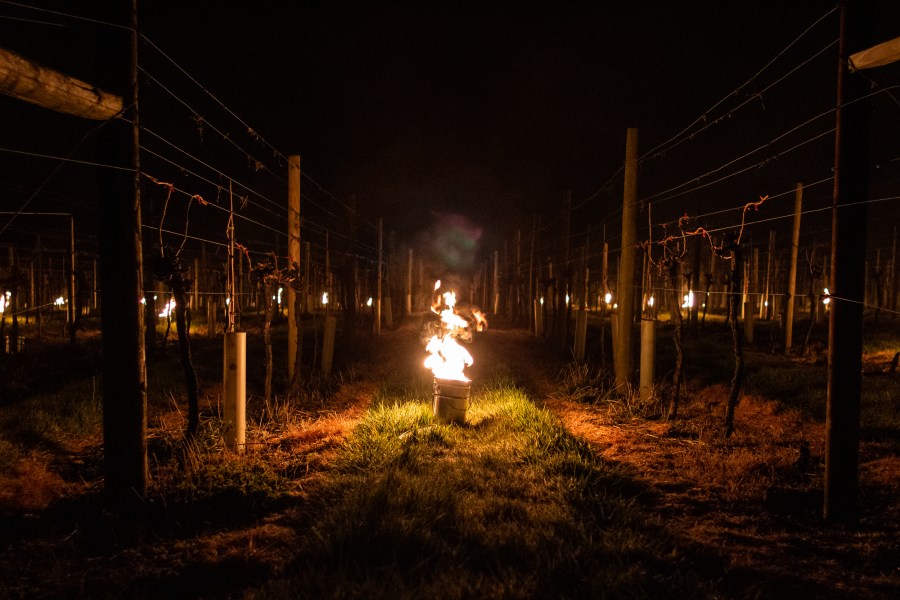
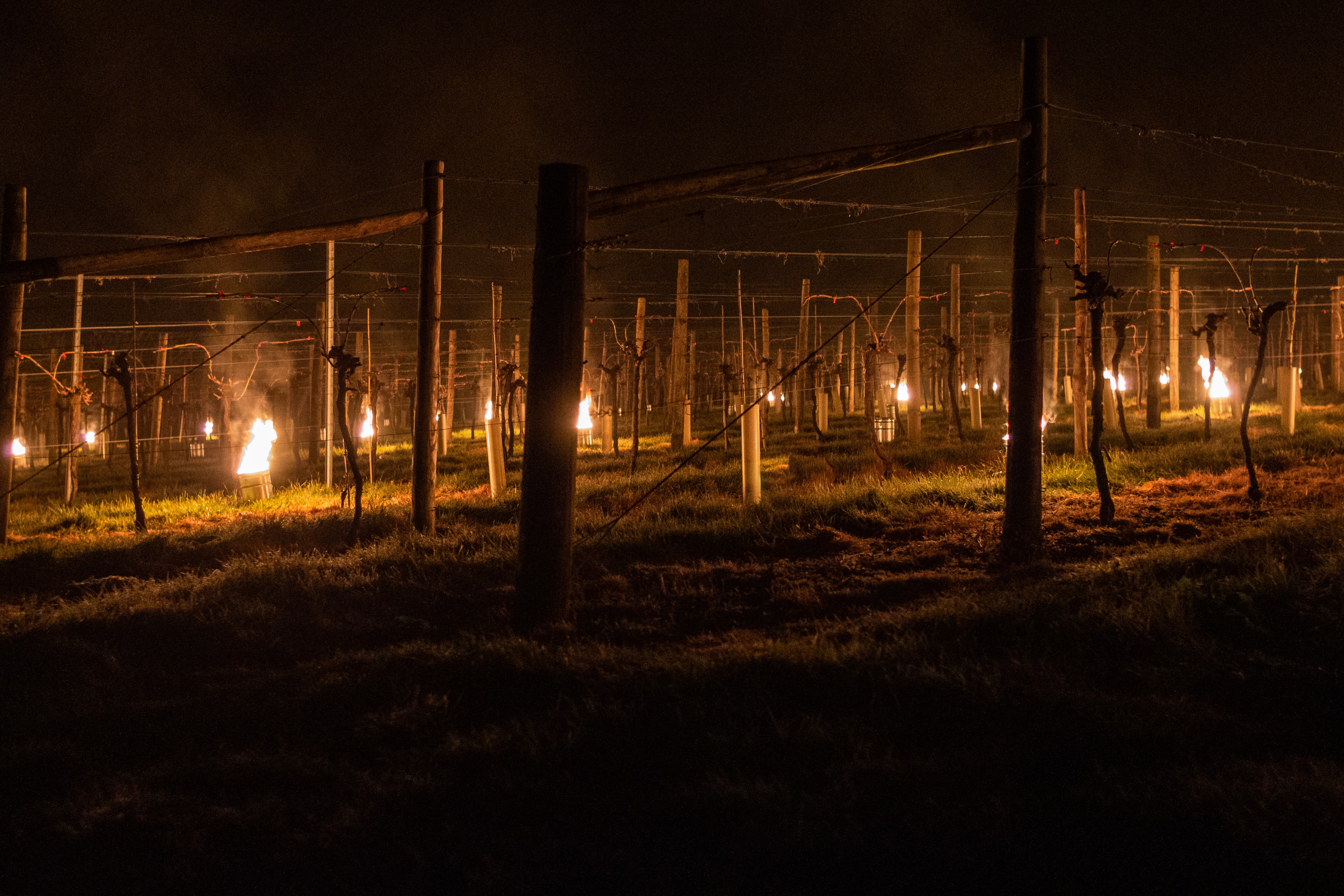
For decades, fire has been used to keep the air around the vines above 0°C. Bougies, also known as frost candles or smudge pots are labour intensive to deploy across frost-prone areas when the alert is sounded, but they are undoubtedly proven to work. As well as warming the air immediately around the candle, they also keep the air moving to prevent frost from settling.
The French brand Stopgel was created in 1995 by a company who were, and remain, grape growers and farmers themselves. They wanted to create a product that answered their own needs, for use in their own vineyards. That goal was to produce candles that were not made from petroleum but still had a high quality performance.
In 2016, they were finally able to move away from using paraffin in their candles altogether, switching to stearin obtained from colza oil. Stearin is a natural raw material that is also used in the production of chewing gum and soap. The Stopgel Green anti-frost candle became the first environmentally friendly product of its kind.
Thanks to this shift in materials, the Stopgel Green candle offers very low smoke emissions compared to the traditional petroleum derived models. The stearin also offers a better performance, as they have a higher calorific value per hour than the petroleum equivalent – up to 50% more energy can be produced.
According to research undertaken with CTIFL -–the French Technical Institute for Fruit and vegetables – around 12.5m KJ of energy is required per hour, per hectare, to prevent heat loss during a spring frost. The Stopgel Green candle generates more than 25,000 KJ per hour, which means that 200 to 500 candles are required per hectare, depending on the intensity of the frost episode. This high calorific value per hour also means that fewer candles are required than when using a paraffin equivalent. Stopgel estimates that for every two of their candles, three petroleum based candles would be needed to reach the same calorific power.
Stopgel have looked to make their products as green as possible, by introducing wicks made of recycled cardboard and supplying the anti-frost candles on pallets that are made from wood which is sourced from responsibly managed forests in France. The move away from fossil fuels has led to a biodegradable product that is made with a biofuel unique to Stopgel.
The candles are provided in metal buckets with a handle and a lid. The buckets are stackable for easy storage and convenient for clean handling. They are simple to both light and extinguish as required, so that they can be deployed precisely as required and as the weather patterns demand.
Stopgel green candles keep the layer of air in contact with the vine above 0°C even when the peripheral temperature reaches down as low as -7°C. The candles have a burn time of around eight hours, and the six litre candles are big enough to allow for the circulation of heated air at the height of the vines.
Case Study: Alder Vineyard
Alder Vineyard in Okehampton, Devon, wrote an excellent blog detailing their first experience of using frost candles in the spring of 2021. A prolonged series of freezing nights meant that while the candles worked excellently, they found themselves running out of burn time by the end of the cold snap.
The team was still able to limit the damage to around 10% of the vineyard, rather than a plausible 75% if no action had been taken. This is a cautionary tale to encourage stocking up and even overstocking on candles if possible since the winter weather is unpredictable, even in short range forecasts
Read the blog for yourself: www.aldervineyard.uk/blog/battling-the-may-frosts-with-our-new-frost-candles/
The new: harnessing latent heat
Aspersion is considered to be one of the most effective methods of protecting vines from frost because it does not rely on the availability of warm air above the vineyard. The traditional method of using aspersion to attack frost is by continuously spraying above the canopy with water from a sprinkler system.
As it turns to ice, the freezing process releases latent heat that creates a warming microclimate and helps to protect the vines. A thin layer of ice continually forms and melts on the plants themselves and the energy released by this process is sufficient to prevent the plant cells themselves from freezing.
However, one company has now developed a new way of using aspersion for frost protection both in the vineyard and for other crops too. Frosco was founded in 2022 to see if an alternative to sprinklers could be developed that would protect plants on demand and at scale without any environmental harm. Founder George Klat picks up the story.
“The inspiration came from a blanket of snow which covered my root crops when I was organic gardening in Herefordshire. It insulated them from the freezing conditions so they were still viable. It’s not a new idea to replicate snow as an insulating blanket, it’s been tried since the 1950s in Canada.
“What occurred to me was that trying to use an insulating blanket on a vine will never work because it’s off the ground and there’s no real thermal mass to insulate. You need something which can insulate but at the same time actively keep the temperature above zero.
“I went to Imperial College’s engineering hub and worked with them on a self-assembling water-based foam that created a sacrificial layer which would freeze first and protect the plant. The magic is that when water freezes it releases a lot of latent heat. By containing that water within a foam structure it acted as an ideal site for ice to form on the surface of the foam. The latent heat that is created flows through to the liquid foam underneath, rather than being wasted to the environment, and it acts like a thermal shock absorber for the plant.”
The foam freezes from the outside in, but since it is generating latent heat on the inside of the ice, between the frozen foam and the liquid, the freezing front cannot reach far enough to affect the plant. Each bubble acts as a surface on which ice can nucleate and cumulatively it makes up a huge surface area, all folded up into tiny compartments. Rather than building up layers of ice by continuous spraying with a sprinkler, all the air-to-liquid layers are neatly presented on a microscopic level.
George has demonstrated that the foam remains stable even in temperatures of -20°C, preventing the ice from permeating far enough to potentially cause damage.
Thanks to the molecular structure of the foam, it freezes coherently, in a controlled fashion, so none of the heat energy is wasted. This makes it more efficient than a sprinkler system, not to mention more water efficient. When applied, the foam is composed of 90% air, 9.9% water and 0.1% prebiotic molecules.
The foam is ultra stable and different compositions have been developed that can withstand either one or several frost events, for use with different types of plant. It is rainproof to a degree, although heavier rain may disperse the product.
The innovation has been tested for over a year at temperatures going down as far as -10°C. The study took place at CRAM, the Centre de Recherche Agroalimentaire de Mirabel in Montreal, and the results of the work are set to be published in a peer reviewed paper by CRAM Director, Andréanne Hébert-Haché.
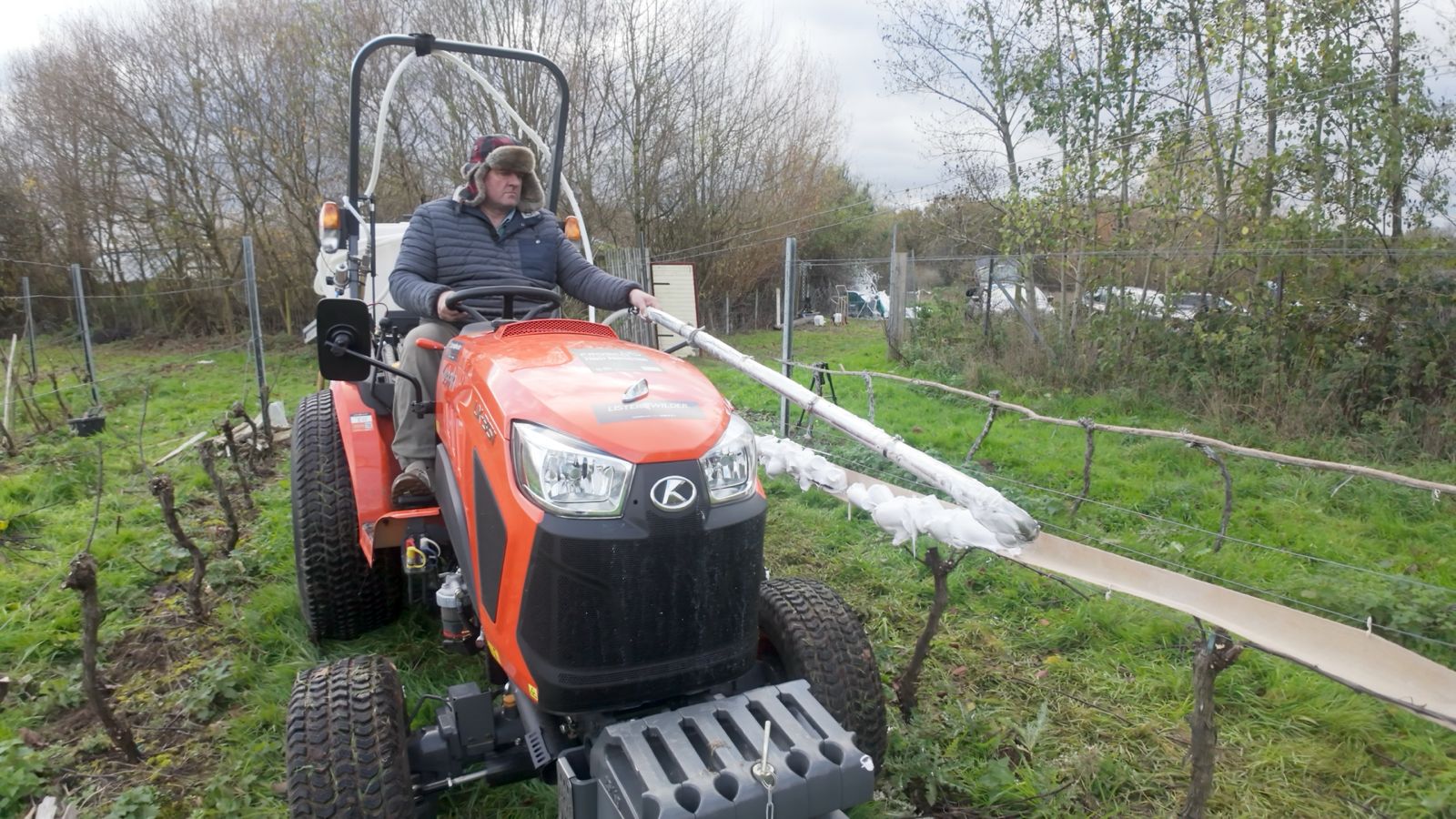
In terms of practicality, the foam is applied by using a regular tractor sprayer linked to an air compressor. Through a simple assembly of valves and a hose, the pressurised air goes into the pressurised liquid feed and the foam is created in the hose. There is a custom nozzle which controls the application of the foam.
Work is underway to test a system where a wide jute ribbon under the fixed wires is used to form a gutter to which smooth pre-bud burst canes are tied down during pruning. This allows for an even faster and more efficient application of the product early in the season. After the leaves open the plants can be sprayed from both sides at once with a simple over the vine gantry, as the foam adheres very readily to open leaves and stems.
The prebiotic molecules that create the structure of the foam are plant based and 100% non-hazardous, so it presents no danger to soil life when it disperses. It is sold as a concentrate usually in 10 litre or 20 litre barrels, although larger quantities are available. The concentrate is diluted by 10 parts water, with 40 litres of concentrate being sufficient for application over one acre. Of course, the product can be applied only in the areas where frost is likely to pool to make Frosco’s use more efficient.
Frosco are currently looking into organic and Demeter accreditation for their products so that they can offer peace of mind for all types of vineyard looking to utilise the interesting new frost solution.
A guardian against advection frosts?
A current investigation in Sweden is examining Frosco’s potential for use in the battle against advective frosts. While the strong winds usually render traditional frost protection methods ineffective, the foam is creating a hard frozen shell in sub zero temperatures which can prevent the wind from permeating to the plant as well as benefiting from the release of latent heat.
At the moment the work is being done with sugar beet plants, but the formulation will need little adaptation to make it suitable for use on grapevines too. This would be a really innovative step forward in the tools available to vineyard managers who wish to take action to prevent spring frosts from causing significant damage to the nascent growth of the new season.
Frosco is distributed through Vine Care. Find out more on their website: www.frosco.io
Well established: biostimulants
CropAid International Ltd have been harnessing the power of the vine’s natural stress-response pathways to help improve their natural protections against lower temperatures. For 20 years now, they have been at the forefront of research into how biostimulants can be used to support growers when extreme temperatures threaten yield and quality.
CropAid AntiFrost is a concentrated liquid which contains organic material and natural enzymes and has been approved for organic use by the Soil Association. It encourages crops including vines to produce their own antifreeze proteins, which provide protection during frost events by preventing ice nucleation. AntiFrost has also been shown to encourage further vitality right through to harvest.
A vineyard trial at Mallard Point Vineyard in Lincolnshire took place in 2025. Temperatures dropped as low as -4°C during the late frosts in May, but the vineyard recorded no frost damage at all.
Mallard Point Vineyard had made three applications of CropAid AntiFrost at a rate of 1l/ha across 200-300l of river water, using an orchard sprayer to ensure full canopy coverage. This included an application as a pre-frost protection measure. The protection lasts up to 14 days per spray, which allows for cover across multiple nights of plummeting temperatures.
As well as impressive levels of frost protection, the Mallard Point vines also exhibited stronger lignification and enhanced canopy growth across all treated vines.
“We’ve never seen leaf health so abundant. I am a firm believer,” said Andrew Beamish, owner and winemaker at Mallard Point. “It’s 100% obvious – why would you not be smiling to see vines as they are?”
Another vineyard, Yorkshire Heart Vineyard, had commented that they had applied it and had no issues at all with the frost and they decided to incorporate it into their spraying programme.
Tim Spakouskas of Yorkshire Heart Vineyard said: “We first used CropAid as a frost protection in May this year, we were forecast a -1°C frost, so were quite concerned. We applied it 24 to 48 hours before, our thermometer recorded -0.8°C during the frost, we had no issues at all. We decided we would add it as a monthly addition, and we feel it really helped with the health of the vines and improved the yield and quality at harvest.”
Growers using CropAid products have reported better level of bud survival after frost events, as well as a reduction in shoot necrosis and better fruit set as the spring progresses. CropAid’s own research has indicated that the AntiFrost product increases the natural cold tolerance of some vines up to 4°C below their normal levels.