
All winemaking starts with soil, and a focus on soil health is vital for ensuring that the fundamental building blocks for successful, productive vines are in place. An important part of that is providing well aerated soils that give young vines the opportunity to develop strong roots in their early years, as well as impacting on water infiltration and nutrient uptake for more established vines.
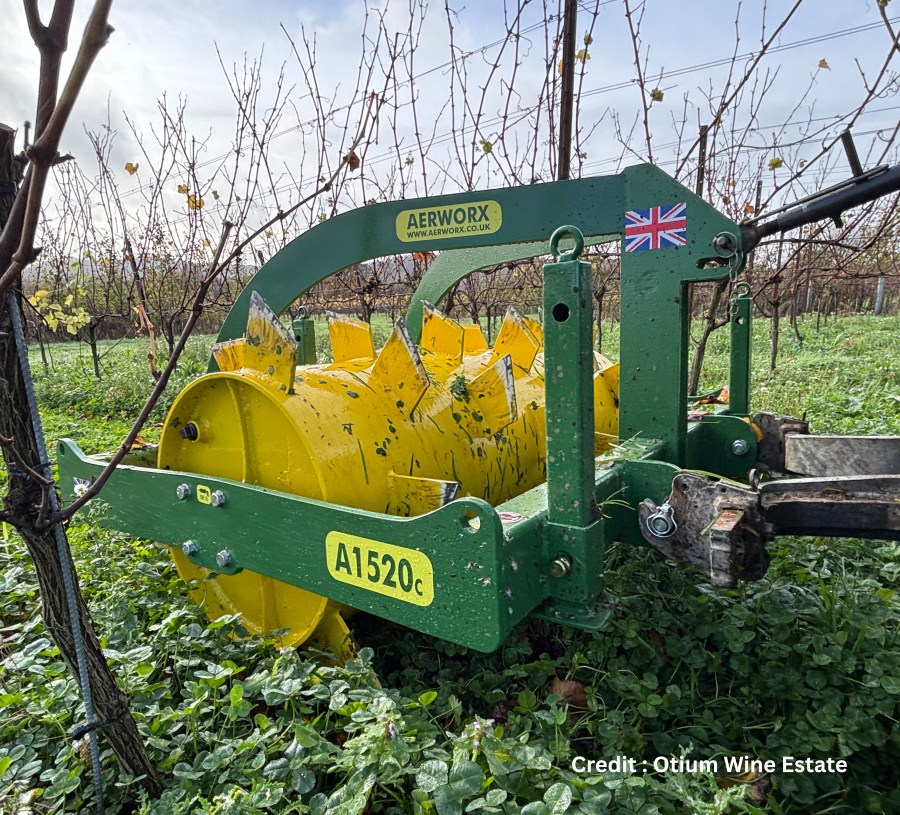
Vineyard Magazine talked to Netty Palliser of Aerworx, experts in soil aeration, to get the inside view on the subject of compaction. Aerworx are a company with roots in the United States, but they have been selling aerators into Europe for almost twenty years. It has grown to such a point that now its Hampshire location has the capacity to fully manufacture machines for the UK market in-house, sourcing all components from Britain.
Why is compaction such a big issue for vineyards specifically?
Unlike other industries, vineyards cannot rotate use or rest the vines’ soil for several seasons and so there is a pressure to optimise soil health to keep it active, open and chemically balanced with the tactical use of management practices such as grazing; cover crop planting; mechanical interventions and the use of biostimulants such as composts and manures.
Despite industry wide discussions about how to reduce traffic wheelings in vineyard rows, the number of annual management tasks naturally results in compacted soils in travelled ground. The soil particles become compressed, squeezing out air and water, as the large and small soil pore spaces collapse.
In turn, infiltration rates reduce depriving both cover crop and vine roots of water; the closed soil structure also deprives the soil biome of water and oxygen. The success of this soil food web that is needed to deliver plant-available nutrients to the roots and contribute to maintaining a functional soil structure, depends on a healthy soil environment to thrive.
Roots struggle to penetrate the compaction pan and become very drought sensitive; soil chemistry changes in response to anaerobic dry or waterlogged conditions.
We visually can see waterlogging; run off (including that of applicants such as biostimulants/ composts) be it within the vineyard or into local water courses (an increasing focus for national waterboards and river trusts); loss of topsoil and erosion despite the planting of cover crops; and poor vine performance with respect to quality, yield and disease resistance.
What are the benefits of aeration and how regularly should it be done?
By alleviating compaction, we aim to break down large blocky soil aggregates into a fine soil crumb opening up macro and micro pores able to capture and retain air and water. Ideally this is done:
- without exposing the soil surface (no-till) in order to prevent carbon/ evaporative losses;
- done with as minimal disturbance to the small amount of precious biology that may be present;
- without damaging vine roots;
- without causing more compaction;
- performed at pace to keep up with rapidly changing climate patterns.
Infiltration rates can take hours in very compacted soils, but a healthy soil ideally should be similar to that of an adjacent unmanaged hedgerow!
Some prefer to aerate as they work negating the effects of wheelings as you pull the aerator behind the vineyard tractor – spraying would be a good example.
What are the longer long term benefits for soil health?
In the long term, alleviating compaction:
- will help to build in vineyard resilience to weather extremes so that the vine conditions are not swinging from deluge to drought. Healthy active soils mean healthy disease-resistant roots – meaning healthy vines and cover crops.
- will help to create an ecosystem that looks after itself with intervention only implemented to negate the impact of the “management musts”.
Is climate change having any impact on soil and the need for aeration?
With clear changes in our climate and the challenge that presents for our soil, we need to consider soil health and tactical, cost effective approaches more than ever.
The extreme weather conditions that the UK has experienced in recent years, has meant that soils swing from dry baked conditions to waterlogged . It is now not uncommon to observe a high volume of rainfall in short periods of time – the soils need to be ready to capture that… and fast. So by ensuring that the soil is a healthy sponge, the vineyard can capture and retain the rain in the wetter months, acting as a reserve for roots to tap into in drier months.
AerWorx
AerWorx achieves significant infiltration rate improvements in a single efficient pass – the start of the transition journey to soil health – something that is acknowledged to take deep tapping cover crop roots years to achieve.
The next phase, having provided an optimal environment for the soil biome, sees the return of biological activity. As well as providing plants/vines with available nutrients such as NPK at the root zone, the biology is integral to maintaining soil structure using organic matter, bacterial sticky glues and a naturally occurring network of fungal hyphae. Cover crops can establish, optimising their benefits, without having to struggle to penetrate the compaction pan, struggle for water (or survive in waterlogged ground) nor compete with compaction loving weeds.
How frequently aeration is required will depend on the level of compaction and on-going management practices. AerWorx is usually performed once in the spring of the first year when the ground is dry (to optimise the shatter effect) and, if required, again at the end of the summer. Once compaction is alleviated, the aim is to hand the gauntlet to a healthy cover crop and optimally functioning soil biome so that a single annual mechanical intervention should be sufficient or when VESS scores and infiltration rate tests dictate the need.
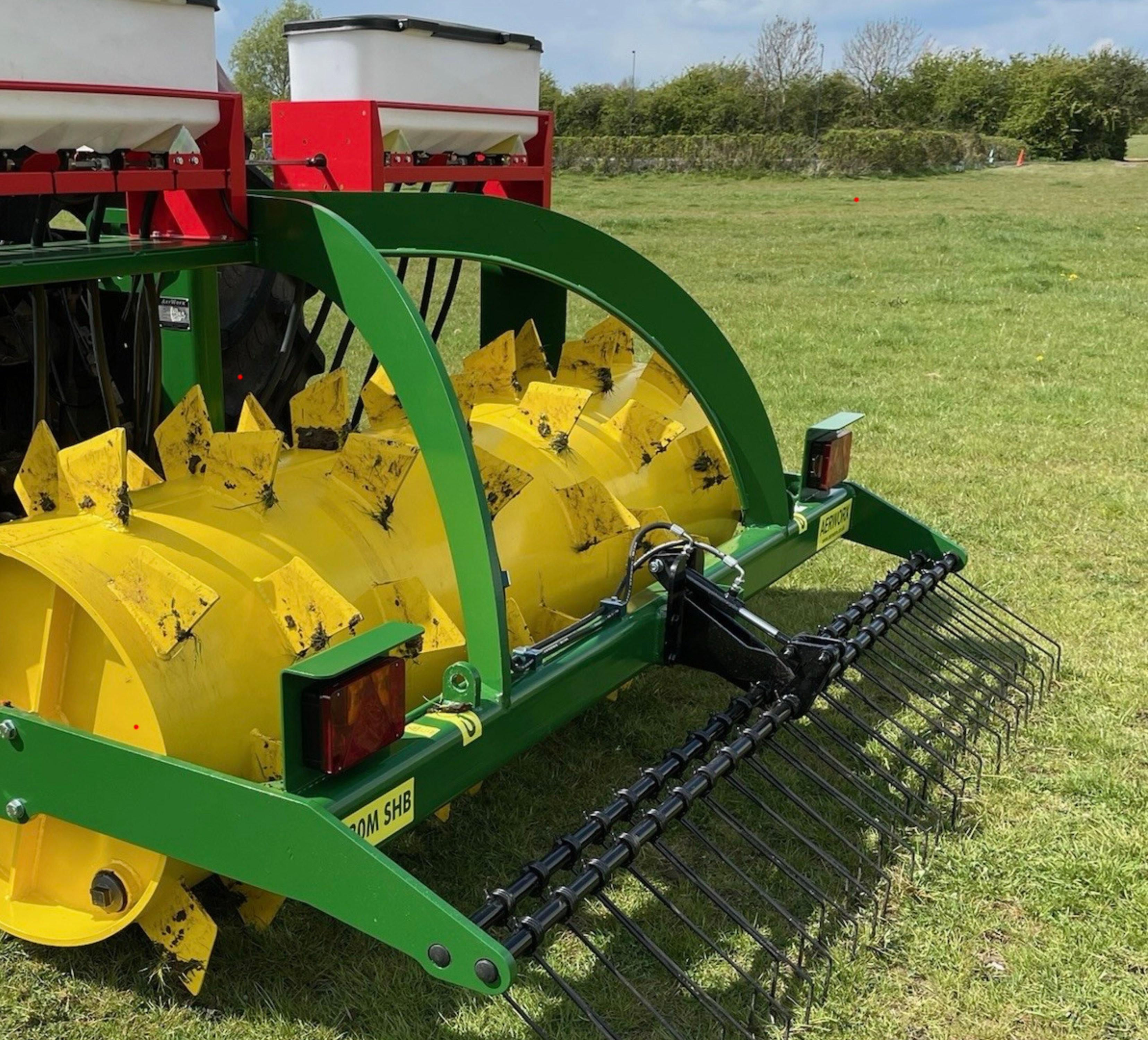
3 in 1 Aerworx seeder and harrow
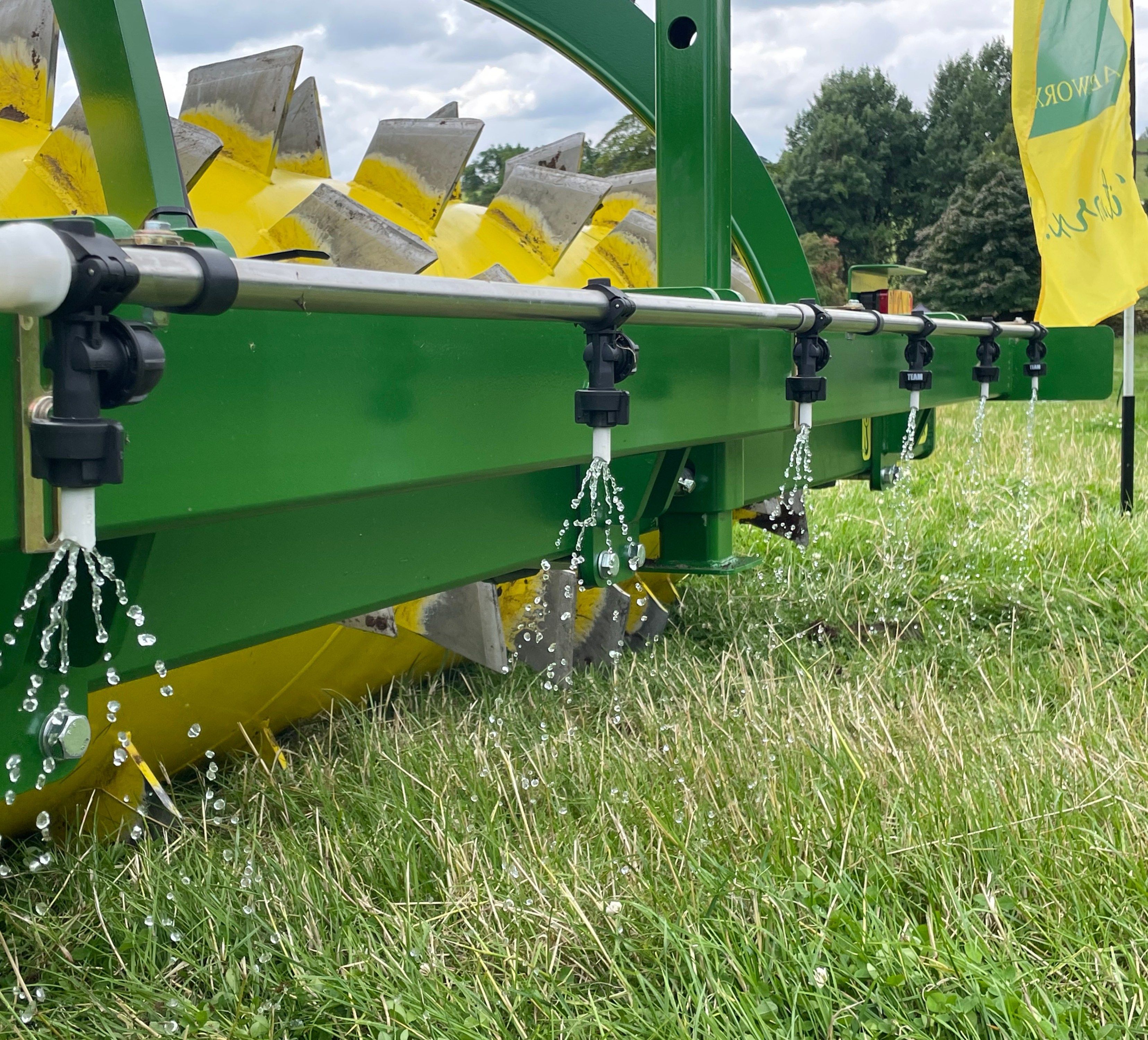
Aerworx plus spray bar
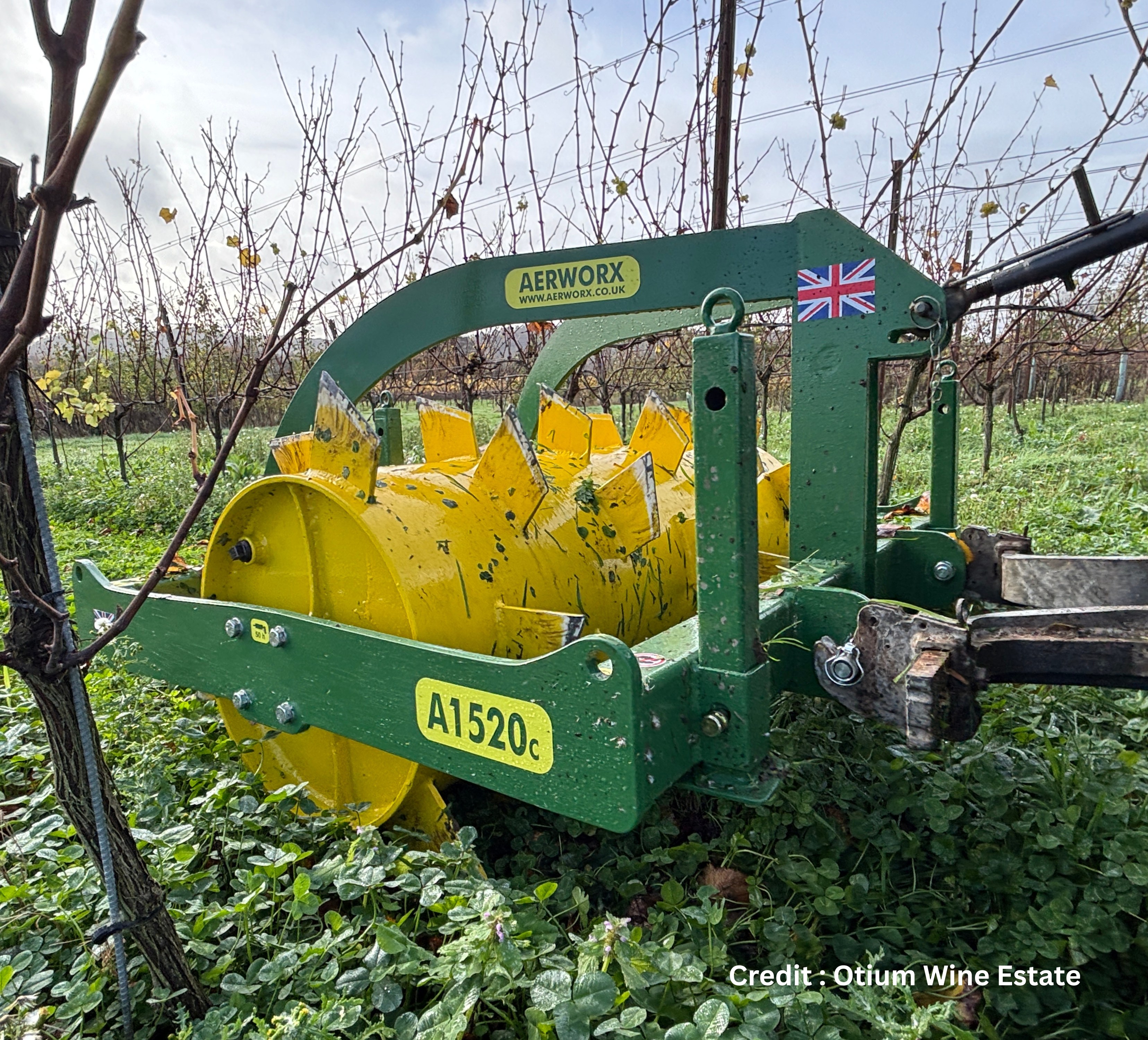
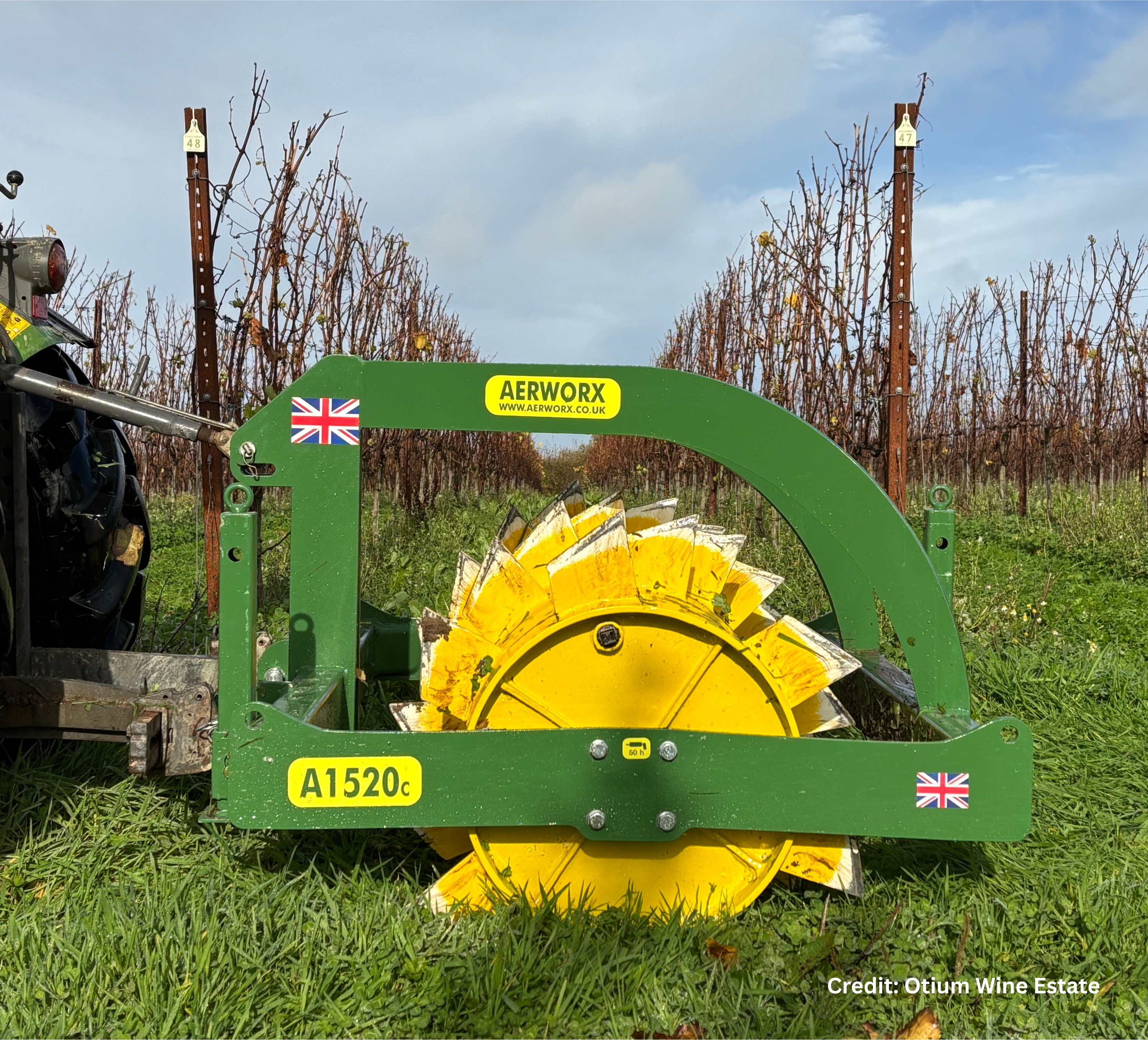
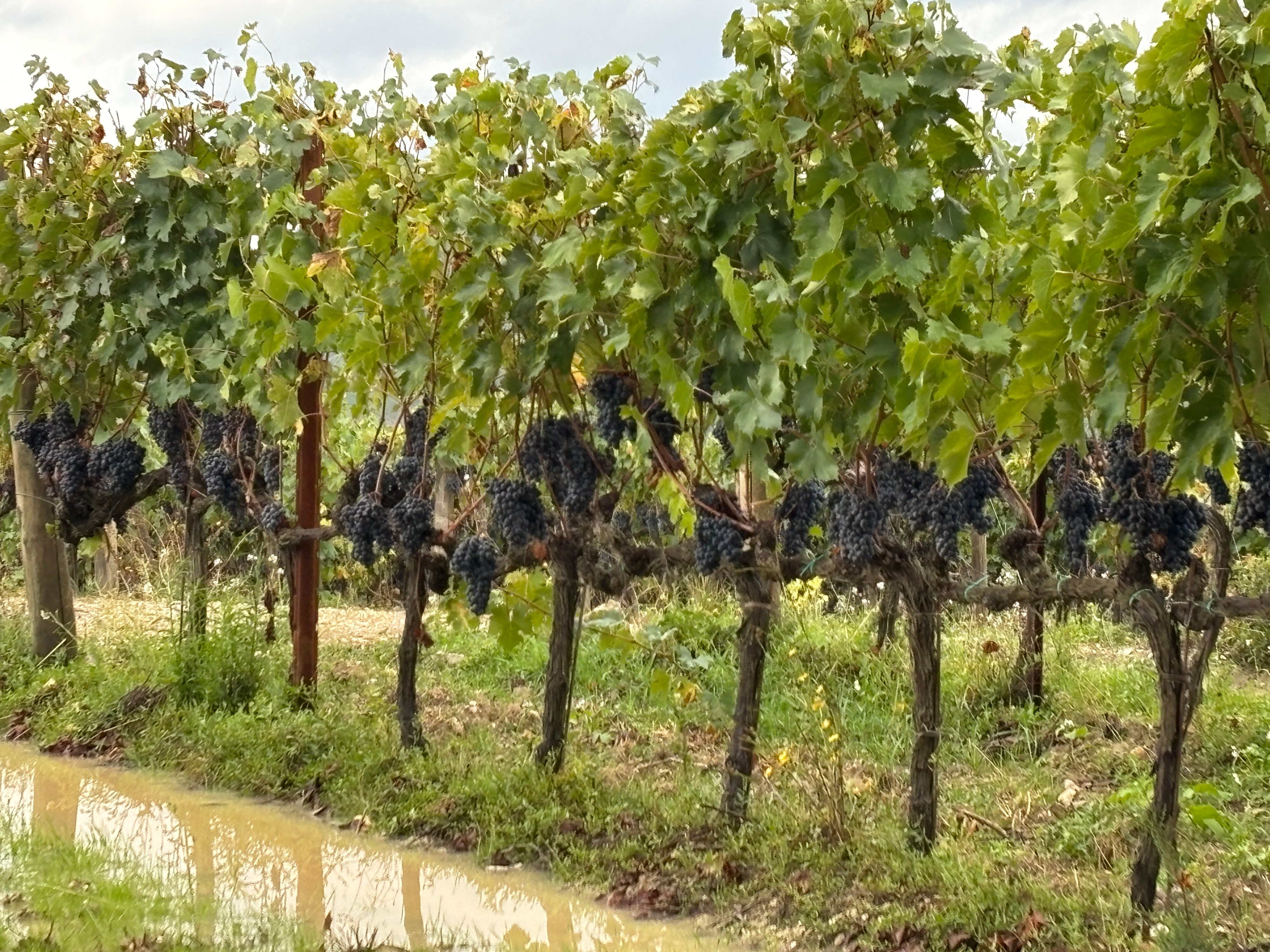
Waterlogging
Funding available for improving soil health
A number of water boards have schemes that offer support and funding to help farmers and land managers to adopt practices that improve soil health and in consequence offer benefits to local water courses.
Here is a list of resources for some of the main water companies across England and Wales. This is not an exhaustive list, but hopefully it will encourage vineyard managers to explore the opportunities.
υ There is also a good deal of useful information available on the Catchment Based Approach website. This is a knowledge hub “for all organisations and individuals interested in participating in collaborative and cross-sector management of the water environment.” The Agricultural Advice Hub offers advice, information and links to support for sustainable farming practices, including links to funding opportunities.
www.catchmentbasedapproach.org
Affinity Water sponsors the regenerative farming event, Groundswell, which takes place near Hitchin, as well as funding cover and companion crops.
www.affinitywater.co.uk/sustainability
Anglian Water offers a small range of grants throughout the year. It is worth making contact with the local Catchment Advisor for more information on what support might be available now to vineyards in the region.
www.anglianwater.co.uk/business/help-and-advice/catchment-services/supporting-farmers
Bournemouth Water runs a catchment-management scheme called Upstream Thinking, to apply natural solutions to reduce agricultural impact on biodiversity and water quality, while supporting farmers and the rural economy.
www.bournemouthwater.co.uk/environment/projects/nature-based-solutions
Bristol Water and Wessex Water are funding partners for the Bristol Avon Catchment Partnership Fund, along with the local councils operating in the area. It is continually open for applications, but private businesses applying to the main grants scheme will need to work in partnership with NGOs or the third sector to have their application accepted.
www.bristolavoncatchment.co.uk/catchment-partnership-fund
Cambridge Water is in the process of administering the first round of funding in their SPRING 2 Environmental Protection Scheme. Keep an eye out for the possibility of a second round of funding opening for applications from farmers in the priority catchments in the next few months.
www.cambridge-water.co.uk/environment/catchment-management/spring/
Dŵr Cymru Welsh Water offers advice and information as part of its WaterSource approach. Find out more on their website.
https://corporate.dwrcymru.com/en/community/environment/our-projects/watersource
Essex & Suffolk Water is part of the East Suffolk Catchment Partnership (along with Anglian Water) which has identified “opportunity areas” where improvement projects would have the most impact. Find out more on the Essex and Suffolk River Trust website. See also Northumbrian Water.
www.essexsuffolkriverstrust.org/east-suffolk-catchment-plan
Hafren Dyfrdwy say they continue to build on work undertaken in 2015 to 2020 to investigate issues and manage water quality risks by engaging with local farmers and other stakeholders.
www.hdcymru.co.uk/about-us/environment/catchment-management/
Northumbrian Water and Essex & Suffolk Water are a part of the Northumbrian Water Group which highlights grant funding opportunities in both areas on its website. They arrange in person meetings to learn more about the farm in question and the opportunities for improving water quality. They have grant funding pots available and can also signpost other funding which may be accessible.
www.nwg.co.uk/responsibility/environment/catchment-land-use
Portsmouth Water offers grants to help reduce nitrate leaching in their priority catchment areas as well as to enhance the habitat network around their sites.
www.cleanwaterpartnership.co.uk/risks-to-water-quality
Severn Trent have been operating a catchment management programme called Farming for Water for the past decade. The first round of funding for their Severn Trent Environmental Protection Scheme, STEPS, programme closed at the end of January, but it is worth local businesses keeping an eye on the resources they are making available.
www.stwater.co.uk/about-us/environment/working-with-farmers-and-land-managers/
South East Water offers free advice and reporting services for land managers, along with workshops and events. There is also a capital grant scheme to help land managers tackle agricultural diffuse pollution. Visit their website to find out more or to register for a free visit.
www.southeastwater.co.uk/about/our-environment/catchment-management
South Staffs Water is in the process of administering the first round of funding in their SPRING 2 Environmental Protection Scheme. Keep an eye out for the possibility of a second round of funding opening for applications from farmers in the priority catchments in the next few months.
www.south-staffs-water.co.uk/environment/catchment-management/spring
South West Water runs a catchment-management scheme called Upstream Thinking, to apply natural solutions to reduce agricultural impact on biodiversity and water quality, while supporting farmers and the rural economy.
www.southwestwater.co.uk/environment/projects/nature-based-solutions
Southern Water offers a Farm Capital Grant Scheme to help pay for new equipment or farm improvements. For land in eligible areas, 50% of project costs, up to £15,000 is offered. There is also an offer of free advice including infrastructure checks and soil health assessments.
www.southernwater.co.uk/about-us/environmental-performance/healthy-rivers-and-seas/catchment-first/
SES Water can offer financial support for land managers in target areas to help protect water quality at source. They promote current initiatives through their Water Friendly Farming leaflet.
www.seswater.co.uk/your-environment/catchment-management
Thames Water offers a Catchment Fund and bespoke water quality improvement projects scheme. Application deadlines are at the end of November and May each year. Its funding is available to address different issues according to location. Please check for details of priority areas.
www.thameswater.co.uk/about-us/environment/smarter-water-catchments
United Utilities describe their approach to managing catchments in an holistic, integrated manner as Catchment Systems Thinking. Find out more about their plans on their website.
www.unitedutilities.com/corporate/responsibility/stakeholders/catchment-systems-thinking/
Wessex Water – see Bristol Water
Yorkshire Water’s land strategy is entitled Beyond Nature in which their 22,000 hectares of farmland will be brought into tenancy to protect the Yorkshire landscape for future generations.The scheme currently has 37 farms across the region but they are also interested in hearing about potential opportunities for collaboration.
www.yorkshirewater.com/environment/beyond-nature/
Using cover crops to capture carbon
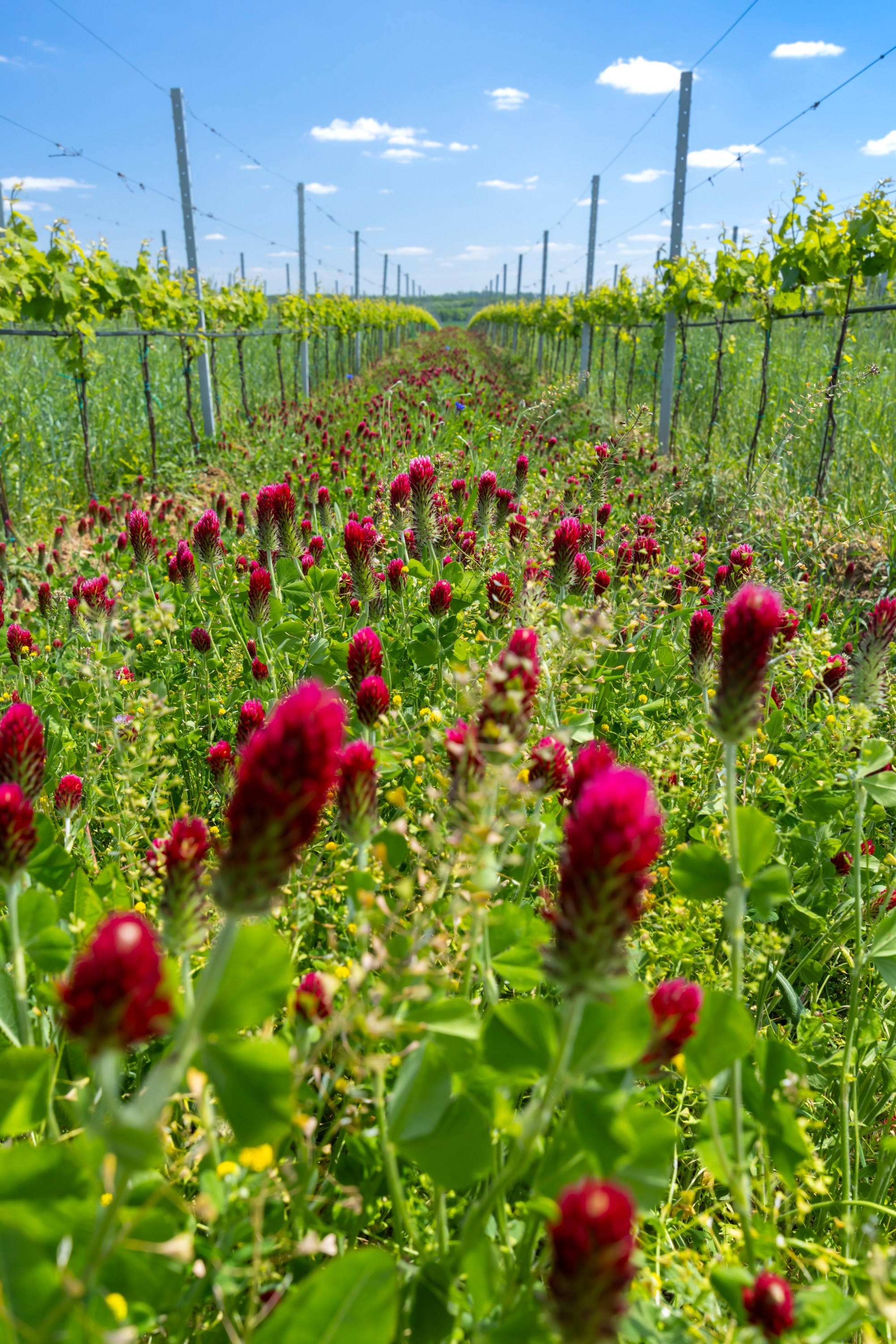
Regenerative practices like cover cropping have now become central to growing wine in a way that is climate smart and has the benefit of actively reducing the carbon footprint of the business concerned. Soils store carbon through organic matter, particularly when enriched by biomass from cover crops.
Eventually this active carbon turns into stable, organic carbon which not only improves the fertility of the soil and the moisture that it can retain, but also offsets emissions from farm operations. Research postulated that cover crops can sequester between 0.5 and 1.5 tonnes of CO2e per hectare per year.
Alongside the sequestering of carbon, cover crops can also promote soil health and fertility, reduce erosion, improve water retention, increase biodiversity and help to manage pests and reduce the loss of nutrients from the soil through leaching.
Cover crops may include a range of different species. Grasses, legumes, cereals or herbs can all be used, and a mixture of species will give the best results and the highest range of benefits. However, even just planting one species of cover crop has been show to be preferable to a default grass base in the vineyard.
Undertaking soil analysis will help make the decision on which cover crops are the right ones for your land. When it comes to planting, direct drilling methods are recommended when seeding new cover crops. Direct drilling is more likely to protect the soil’s structure in comparison to full-field cultivation.
Keen to find out more about the latest research on carbon management and removal?
Read more about the outcomes of the first two European Carbon Farming Summits: www.carbonfarmingsummit.eu/resources
Did you know?
It takes 500 years to create one inch of top soil. This makes it a non-renewable resource – a natural material that cannot be replaced within a human lifetime once it is used up.